
Signavanc™ nurse calling systems
Wireless, IP and wired nurse call systems for hospitals, ICUs, nursing homes and senior-living facilities — designed and manufactured in Bengaluru since 2001, and engineered to meet NABH patient-call requirements.
The system a patient reaches for when it matters
A nurse calling system lets a patient summon a nurse from the bedside, or from a toilet or shower pull-cord, and puts that call in front of staff instantly — the exact room and bed, with an audible and visible alert that latches until a nurse resets it. A call is never silently cleared.
Every Signavanc™ model on this page covers the clinical essentials: a call point at every bed and patient-accessible washroom, corridor door indicators, and a differentiated Code Blue mode for cardiac emergencies. All are engineered to meet NABH patient-call accreditation requirements, so the choice below is about how the system connects and how much it does beyond the call — not about whether it will pass an audit.
Choose how it connects
The first decision is not the feature list — it is whether cable can reach the bedside, and whether the ward can be disturbed to lay it.
Wireless
Signavanc LR · Signavanc Air
No cabling to the bedside.
- Fits an occupied ward — no civil work
- Mobile nurse app and escalation
- Long-range radio or Wi-Fi
IP
Signavanc IP · Cat 5/6 + fibre
Wired on structured data cabling.
- 12-port hub, fibre-optic communication
- Star — a dedicated cable run to every bed
- The most deterministic option
Wired
Signavanc Ultra · Signavanc Lite
Wired on ordinary 4-core cable.
- Ultra — LCD station, reports, multi-colour
- Lite — dot-matrix ward panel
- No Cat 5/6 needed
All five models side by side
Capacity is quoted per nurse station. Model names link straight to full detail.
| Model | Connectivity | Calling units / station | Mobile & SMS | Reports | Best for |
|---|---|---|---|---|---|
| IPSignavanc IP | Wired — 12-port hub, Cat 5/6 + fibre | 100+ | Central + per station | New builds and rewires, ICUs, the most deterministic option | |
| WirelessSignavanc LR | Wireless — 433 MHz, FHSS mesh | Up to 256 | Central + per station | Retrofits, thick walls, basements, multi-block campuses | |
| WirelessSignavanc Air | Wireless — IP over Wi-Fi | Unlimited on hospital Wi-Fi · 30 on our own network | Central + per station | Occupied wards needing the fastest full-feature rollout | |
| WiredSignavanc Ultra | Wired — 26-port hub, 4-core cable | Up to 56 | Central + per station | An LCD nurse station in a building with no Cat 5/6 cabling | |
| WiredSignavanc Lite | Wired — dot-matrix panel | Up to 26 | — | Structured wards where the essentials are what the budget should buy |
Every model covers bedside calls, pull-cords, door indicators and Code Blue. Multi-colour door indicators, centralised reporting and Turn Over Time — the ward's average response, kept on the nurse-station screen — come with every model except Signavanc Lite. Mobile access, escalation apps, SMS alerts and cloud dashboards are on the two wireless models; HIS / EMR integration is optional on those two and on Signavanc Ultra. On every wired model the cabling is laid by the hospital's own contractor — we do not undertake cabling.
You may not need one model. You may need four.
A hospital is rarely one building. A block going up should be cabled; a sixty-year-old ward that cannot close should not; a floor opening next month needs whatever is quickest. Those are different answers, and running different models in different wards is not a compromise — it is the same decision made correctly four times, with one consolidated set of response reports across all of them.
How a hybrid estate worksWhat joins up
Centralised reporting spans every station in the estate. Mobile oversight and the head-nurse app stay with the wireless wards — which is why it is worth deciding on the drawing rather than after handover.
Built for real wards, not spec sheets.
These run through the whole range, and where something applies to only some models it says so. Full specifications, planning and installation detail live on each model page.
Real-time nurse-station console
Every call surfaces instantly with the exact room and bed, and the alert stays active until a nurse resets it. Signavanc LR, Signavanc Air, Signavanc IP and Signavanc Ultra all run a live LCD console showing the whole ward at a glance, and any of them can add a mini nurse kiosk nearer the beds it serves. The station is not the only place a call can land: housekeeping and pantry calls can be routed to an LCD screen in the room or area that answers them — the pantry sees pantry calls, housekeeping sees housekeeping — so a request that has nothing to do with clinical staff does not queue behind clinical ones at the nurse station.
Bedside, pull-cords, Code Blue & multi-colour indicators
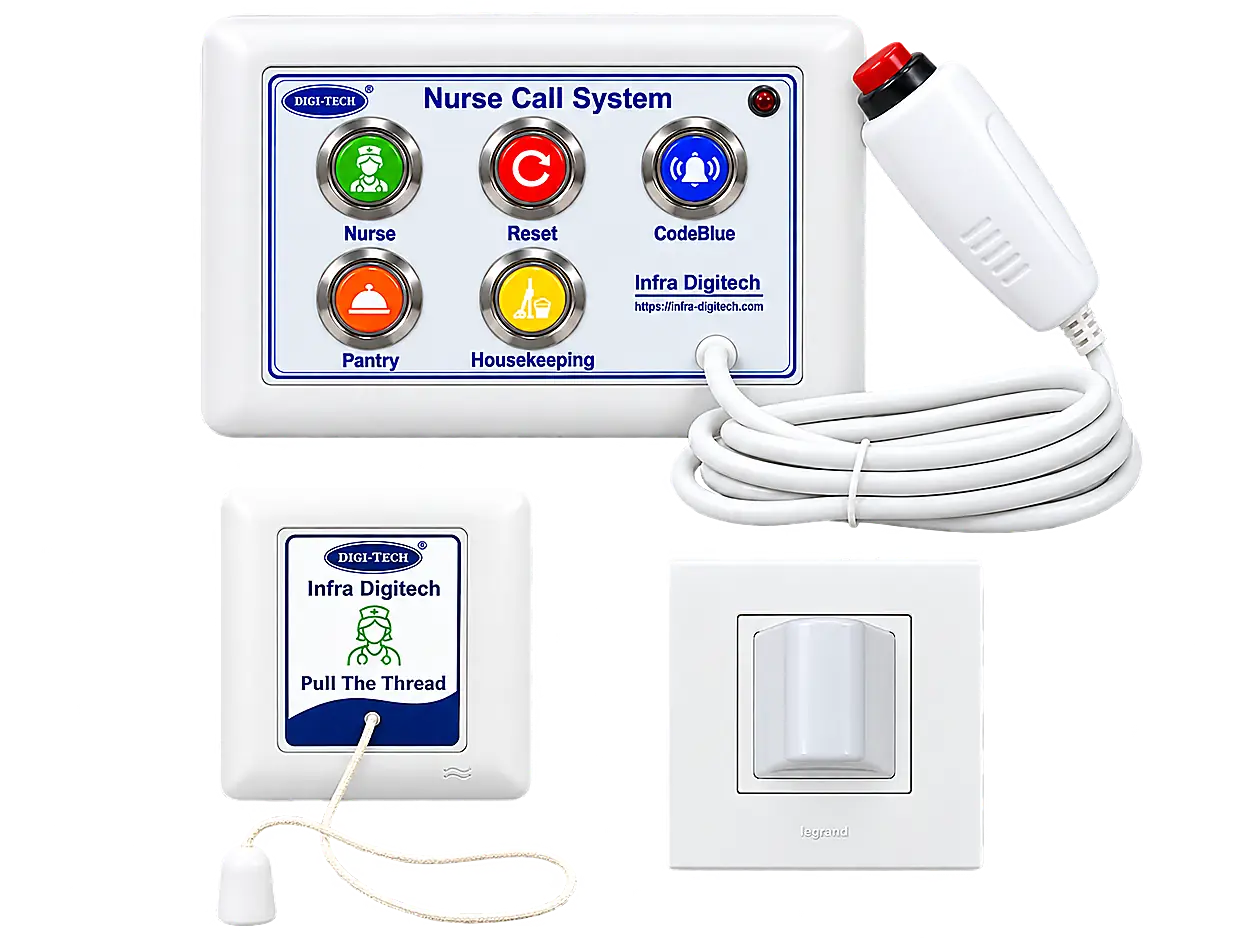
Bedside call points, waterproof toilet and shower pull-cords and corridor door indicators cover every patient-accessible point. The bedside unit comes in three sizes, so a ward orders the buttons it will actually use: a 2-module unit with call, reset and Code Blue — or call, Code Blue and housekeeping, where a long press on call does the reset; a 3-module unit with call, reset, Code Blue and housekeeping; and a 4-module unit that adds pantry. All three are available on every model except Signavanc Lite, which has its own fixed unit, and Signavanc LR takes the 3- or 4-module unit rather than the 2-module. On every model except Lite the door indicators are multi-colour, so each call type reads from the corridor without looking at a panel; Lite uses a single red indicator.
Mobile nurse access & SMS escalation
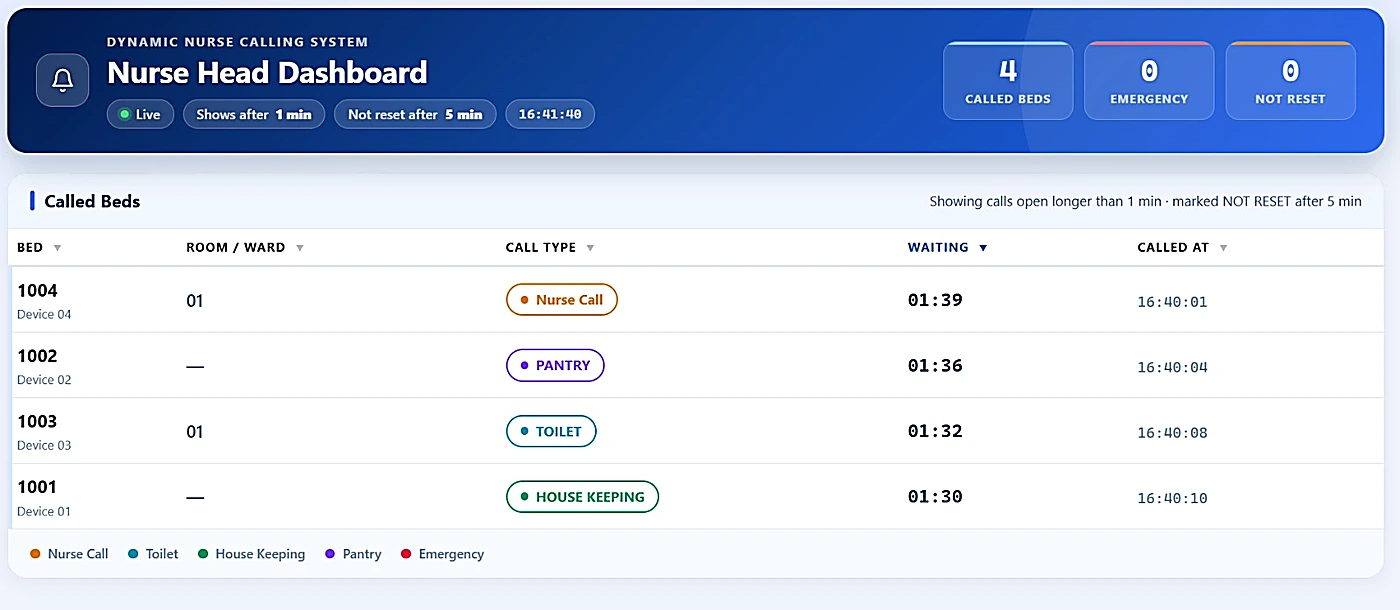
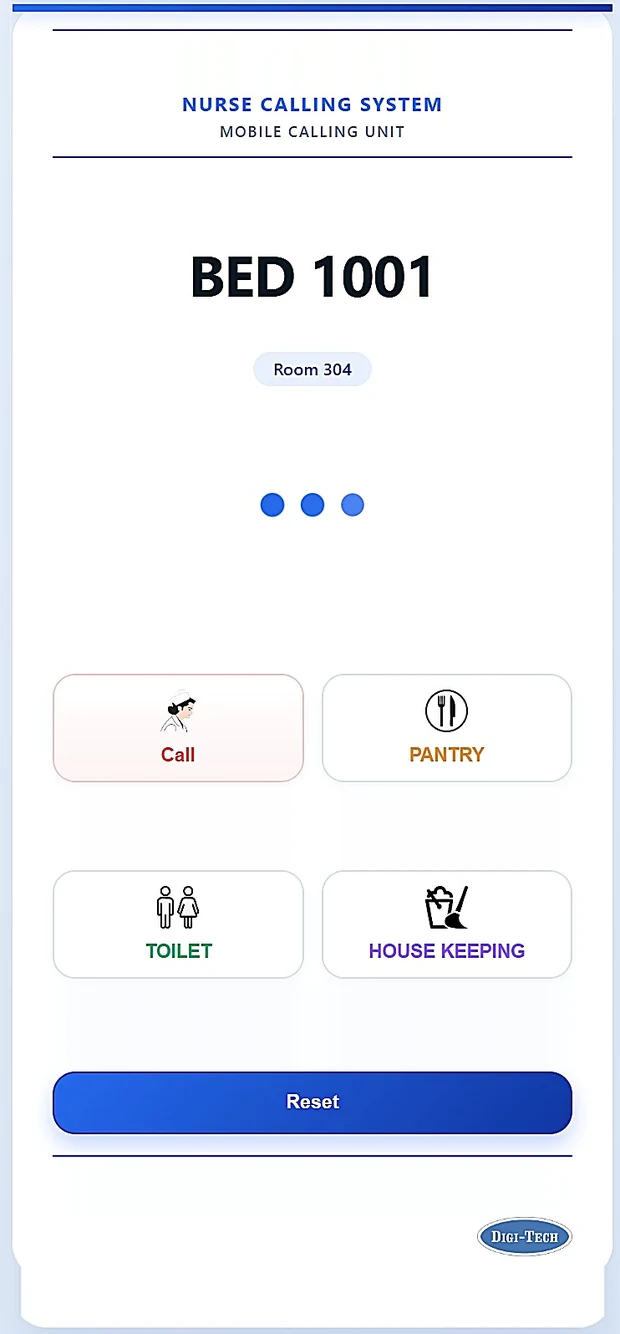
On the two wireless models, nurses receive and clear calls from a mobile calling unit, and a call nobody has answered inside a time you set surfaces on the head-nurse dashboard with its bed, call type and waiting time. SMS alerts to staff away from a screen are available as an option — so no call is lost on a busy round or at shift change.
Voice announcement in every Indian language
On every model except Signavanc Lite the system announces the call aloud as well as showing it — the room and bed spoken at the nurse station, so a nurse with her back to the console or her hands occupied still knows which bed is calling. Announcements are available in English and all Indian regional languages, set to whatever the ward staff actually speak rather than to a default nobody uses.
Illuminated IP65 calling buttons
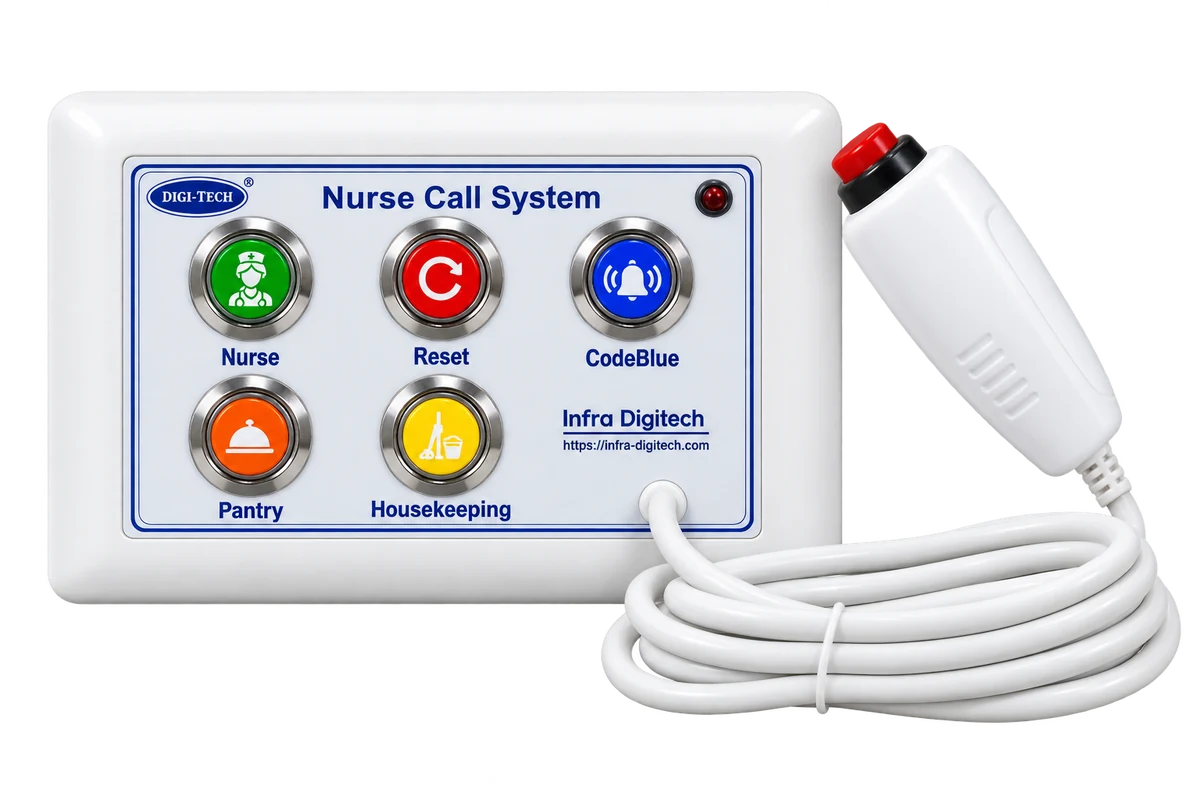
12 V IP65 stainless-steel LED buttons — red, green, blue, yellow and white — let a patient find and press the right one in a dark ward, with a pendant on a lead for anyone who cannot turn towards the wall. The unit comes as a 2, 3 or 4 module box, so a ward takes call, reset and Code Blue, or adds housekeeping, or adds pantry as well, and installation drops into the electrical fit-out.
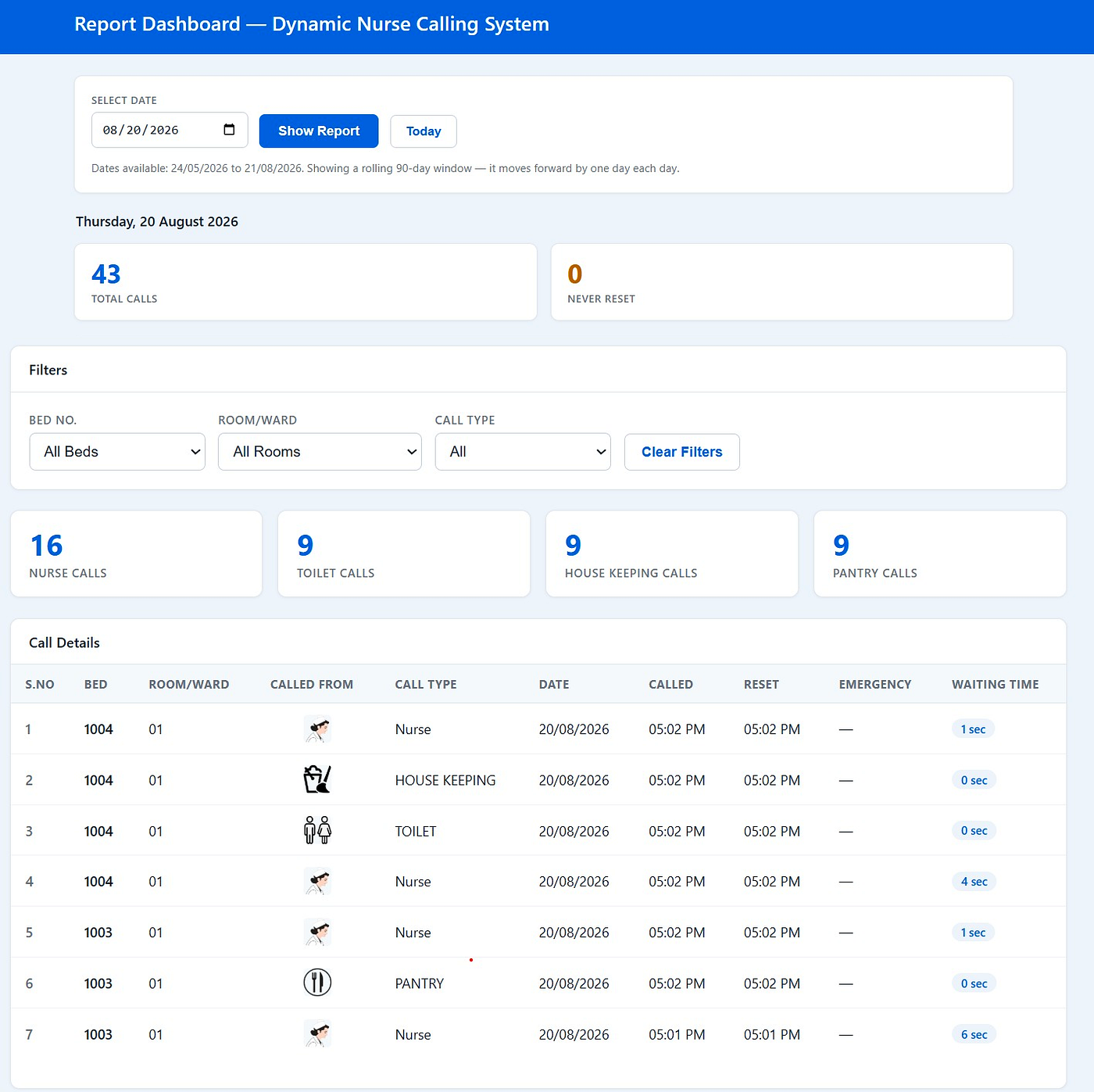
Reporting, dashboards & HIS / EMR integration
Every model except Signavanc Lite logs all call activity, response times and staff performance, and reports can be pulled two ways — at each individual nurse station for that ward, or centrally for the whole hospital. Where those reports go depends on the model. Signavanc LR and Signavanc Air push centralised reports to the cloud so dashboards and analytics can be built on top, and both integrate with your HIS / EMR. Signavanc IP keeps reporting on site and writes into your hospital's own on-premise server. Signavanc Ultra holds its ward and centralised reports on the on-site server we supply, and offers optional HIS / EMR integration too. Signavanc Lite has no reporting module. On Signavanc Ultra and Signavanc IP, consolidating reports across several wards needs a Cat 5/6 run with an RJ45 jack from each nurse-station server back to the central server — worth putting on the cable schedule early.
Turn Over Time — how fast the ward actually answers
Every model except Signavanc Lite keeps a running Turn Over Time: the average interval between a patient pressing a call and a nurse clearing it. It is calculated on the system itself from the first day after installation, so the figure is your ward's own history rather than a number typed into a report, and it is shown on the nurse-station LCD alongside the live calls — not buried in a monthly export. A head nurse or administrator can see at a glance whether a shift, a ward or a staffing change moved response times. The console figure is the live one, and the same data downloads as a report for any period you choose — a shift, a week, a month, a quarter, or between two dates — for one ward at its own station or consolidated across the hospital, which is what lets you compare a ward against itself before and after a change. It is also what makes an NABH or JCI response-time claim defensible, because the record was captured continuously rather than sampled during an audit week.
Engineered for dead-zone-free coverage
Each model reaches the whole ward a different way. Signavanc IP runs a star over structured cabling, giving every call point its own dedicated run so nothing is daisy-chained and one bed's fault cannot reach another. Signavanc LR uses Frequency-Hopping Spread Spectrum on the 433 MHz band across a self-healing mesh, where each calling unit can relay for its neighbours — which is what carries signal through thick masonry and basement levels. Signavanc Air extends instead with repeaters wherever coverage is needed, and a wired link where a block sits in a separate building. Wide 110–240 V input, rustproof cabinets and UPS-backed control keep the ward covered through power cuts.
The details that show up during installation
Fits 2, 3 and 4 module boxes
Call points mount in standard modular boxes, so the electrician treats them like any other switch — no bespoke back-boxes, no carpentry, faster installation.
How pull-cords and indicators connect
On the wired and IP models the toilet pull-cord and the corridor door indicator run to the bedside calling unit on 2-core cable. On the two wireless models they link to it over the air instead — or on 2-core cable if the hospital would rather have that part wired.
On-site reporting server
Every model except Signavanc Lite includes a compact server that receives the calls and stores the logs, so reports download on site without depending on a cloud connection — for the ward at its own station, or consolidated for the whole hospital.
Cabling you already have
Signavanc IP runs on structured Cat 5/6 with fibre-optic communication between hubs — high-speed and the right choice when a building is being built or rewired. Signavanc Ultra runs a 26-port hub on ordinary 4-core cable, so a hospital that never had Cat 5/6 pulled can still have a wired system with an LCD nurse station.
Mini nurse kiosk
Signavanc LR, Signavanc Air, Signavanc IP and Signavanc Ultra can all be extended with a mini nurse kiosk — a compact secondary display placed nearer the beds, so calls are seen without walking back to the main station on a long ward.
Reminders scheduled against a bed
On every model except Signavanc Lite, staff can schedule a prompt for a particular bed at a particular time — a dose of medicine, a blood sample, a drip bottle that has to be changed. It appears as a coloured card at the nurse station when it falls due and keeps repeating until the calling unit at that bed is reset, so it cannot be glanced at and forgotten.
5 V at the bedside
Every device in the system runs on 5 V. Extra-low voltage at the bed, the pull-cord and the door indicator means nothing a patient or a cleaner can reach carries mains — which matters in a wet toilet or shower area, and makes the install a low-voltage job rather than an electrical one.
Bed numbers set from the app
On every model except Signavanc Lite, bed and room numbering is configured in the app — so when a ward is renumbered, a bay is split or a bed is added, your own staff change it in a minute instead of booking a service visit.
Built around your ward, not a catalogue
Twenty-five years of building nurse call systems for every kind of hospital means deep customisation is normal for us — call types, escalation rules, colour mapping, reporting and integrations are configured to how your ward actually runs.
Don't need Code Blue or NABH?
Plenty of clinics, small wards, nursing homes and non-clinical sites just need a patient or a staff member to reach someone — without pull-cords, door indicators, audit reporting or accreditation. That is what our call bell range is for, at a fraction of the cost and complexity.
See the full call bell rangeFrom a single ward to a multi-block hospital.
Chosen by leading hospitals across India.
5,500+ installations since 2001 — from multi-speciality chains to nursing homes. A few of the healthcare institutions that rely on our systems:















Before you specify
How to Choose a Nurse Calling System: NABH-Compliant Buyer's Guide 2026
A procurement framework for Indian hospitals chasing or renewing NABH accreditation — what the standard actually requires, how to size the system for your ward layout, and the questions to ask every vendor before signing.
Read the guide
Best Nurse Calling System for Hospitals in India: Wired, Wireless, IP and Hybrid Compared
There is no single 'best' nurse call system — there is the right architecture for your ward layout, building stage and budget. A practical comparison of wired, wireless, IP-based and hybrid nurse calling systems for Indian hospitals, with realistic price expectations and a selection framework by hospital size.
Read the guide
Nurse Calling System Price in India (2026): An Honest Guide from a Manufacturer
Most vendors hide nurse call pricing behind 'request a quote'. As the manufacturer, we would rather you walk into the conversation informed: real per-unit prices, what a 10-bed clinic vs a 100-bed hospital actually spends, what moves the price up or down, and the lifetime costs nobody mentions.
Read the guideNurse call — common questions
Planning a ward, comparing models or preparing an NABH submission? Our engineering team will give you a straight recommendation.
What is a nurse calling system?
A nurse calling system lets a patient summon a nurse from the bedside — or from a toilet or shower pull-cord — and shows that call, with the exact room and bed number, at the nurse station with an audible and visible alert that stays active until it is reset. It is the core patient-to-staff communication infrastructure in hospitals, ICUs, nursing homes and senior-living facilities, and a functioning system is a requirement under NABH patient-safety accreditation.
Which nurse call systems does Infra DigiTech make?
Five models across three connectivity types. Wireless: Signavanc LR, a long-range 433 MHz FHSS mesh system supporting up to 256 calling units per nurse station, and Signavanc Air, an IP-over-Wi-Fi system. IP: Signavanc IP, our hub-based wired platform on structured Cat 5/6 cabling with fibre-optic communication and a star topology. Wired: Signavanc Ultra, an LCD nurse station running on a 26-port hub over ordinary 4-core cable, and Signavanc Lite, the dot-matrix ward panel. Every model supports bedside call points, toilet pull-cords, Code Blue and door indicators; every model except Signavanc Lite adds multi-colour door indicators and centralised reporting, and the two wireless models add mobile access, escalation and cloud dashboards. HIS / EMR integration is an option on Signavanc LR, Signavanc Air and Signavanc Ultra.
How many calling units can one nurse station handle?
It depends on the model. Signavanc LR supports up to 256 calling units per nurse station. Signavanc Air is effectively unlimited when it runs on the hospital's own Wi-Fi, or 30 units when it runs on a network our system generates itself. Signavanc IP supports over 100 units per nurse station on its 12-port hub, running on Cat 5/6 with fibre-optic communication. On the wired range, Signavanc Ultra supports up to 56 units on a 26-port hub over 4-core cable, and Signavanc Lite up to 26.
Should we choose wireless, IP or wired?
Choose wireless if the ward is occupied and cannot be closed for cabling, if the building has thick walls or basement levels, or if you want mobile access and escalation. Choose IP if the building is being constructed or rewired and you want the most deterministic system, with no radio planning at all. Choose wired if the building is already cabled the traditional way: Signavanc Ultra gives you an LCD nurse station, multi-colour indicators and centralised reporting on ordinary 4-core cable when Cat 5/6 was never pulled, and Signavanc Lite gives accurate room and bed identification at the lowest cost per bed. If cloud dashboards matter, that points to the two wireless models; HIS / EMR integration is optional on those two and on Signavanc Ultra, while Signavanc IP reports into your hospital's own on-premise server instead. On every wired model the cabling itself is laid by your contractor, not by us.
Do we get reports and analytics?
Yes on every model except Signavanc Lite. The system logs all call activity, response times and staff performance, giving detailed insight for improving ward efficiency, and reports can be pulled at each individual nurse station for that ward or centrally for the whole hospital. Where they go depends on the model: Signavanc LR and Signavanc Air push centralised reports to the cloud, so dashboards and analytics can be built on top, and both integrate with your HIS / EMR. Signavanc IP keeps reporting on site and writes into your hospital's own on-premise server, and Signavanc Ultra holds its ward and centralised reports on the on-site server we supply, with HIS / EMR integration available as an option. Signavanc Lite does not include reporting. On Signavanc Ultra and Signavanc IP, hospital-wide consolidation needs a Cat 5/6 link with an RJ45 jack from each nurse-station server to the central server. Custom analytics can be built to your requirement.
What is Turn Over Time (TOT) and which models show it?
Turn Over Time is the average interval between a patient pressing a call and a nurse clearing it, calculated by the system itself and displayed on the nurse-station LCD next to the live calls. It starts counting on the first day after installation, so what you are reading is your own ward's history rather than a figure assembled for a report. Every model except Signavanc Lite shows it — Signavanc Ultra, Signavanc IP, Signavanc LR and Signavanc Air. For a head nurse it answers the question a call log cannot answer at a glance: is this shift responding as quickly as the last one. For an administrator comparing wards, or defending a response-time claim in an NABH or JCI submission, it matters that the figure was recorded continuously rather than sampled during an audit week. The figure on the console is live, and the same data downloads as a report for any period you choose — a shift, a week, a month, a quarter or between two dates — per ward at its own station or consolidated for the whole hospital. Signavanc Lite has no reporting module and therefore no TOT; if response measurement is a requirement, that is the reason to move up to Signavanc Ultra.
Is the system NABH compliant?
Yes. Our systems are engineered to meet NABH patient-call accreditation requirements — a call point at every bed and patient-accessible washroom, an audible and visible indication at the nurse station of which bed is calling, calls that latch until reset rather than auto-clearing, and a differentiated Code Blue. On those three models, response-time records can be exported for clinical audit.
Can pull-cords and door indicators be wireless too?
On the wireless models, yes. Toilet and shower pull-cords and corridor door indicators can connect back to the calling unit over Wi-Fi or RF, or by 2-core cable if the hospital would rather have a wired link. We plan the mix during the site survey to suit the building.
What is the difference between a nurse calling system and a call bell system?
A nurse calling system is ward-grade infrastructure: toilet pull-cords, corridor door indicators, Code Blue, latching calls, reporting for NABH audit and — on the wireless models — mobile access and escalation. A call bell system covers the essential act of reaching staff without that compliance layer, and suits clinics, small wards and non-clinical settings. If you do not need Code Blue or NABH, the call bell range is the more sensible spend.
Do you install and service across India?
Yes. We design and manufacture in Bengaluru and install and service across India through our own engineering teams and authorised channel partners, with structured AMC plans. We have delivered 5,500+ installations in India and abroad since 2001.
Specifying a nurse call system?
Tell us your ward layout and bed count and we will recommend the right model — with a same-day quotation.