
Bengaluru, India — 2 September 2026
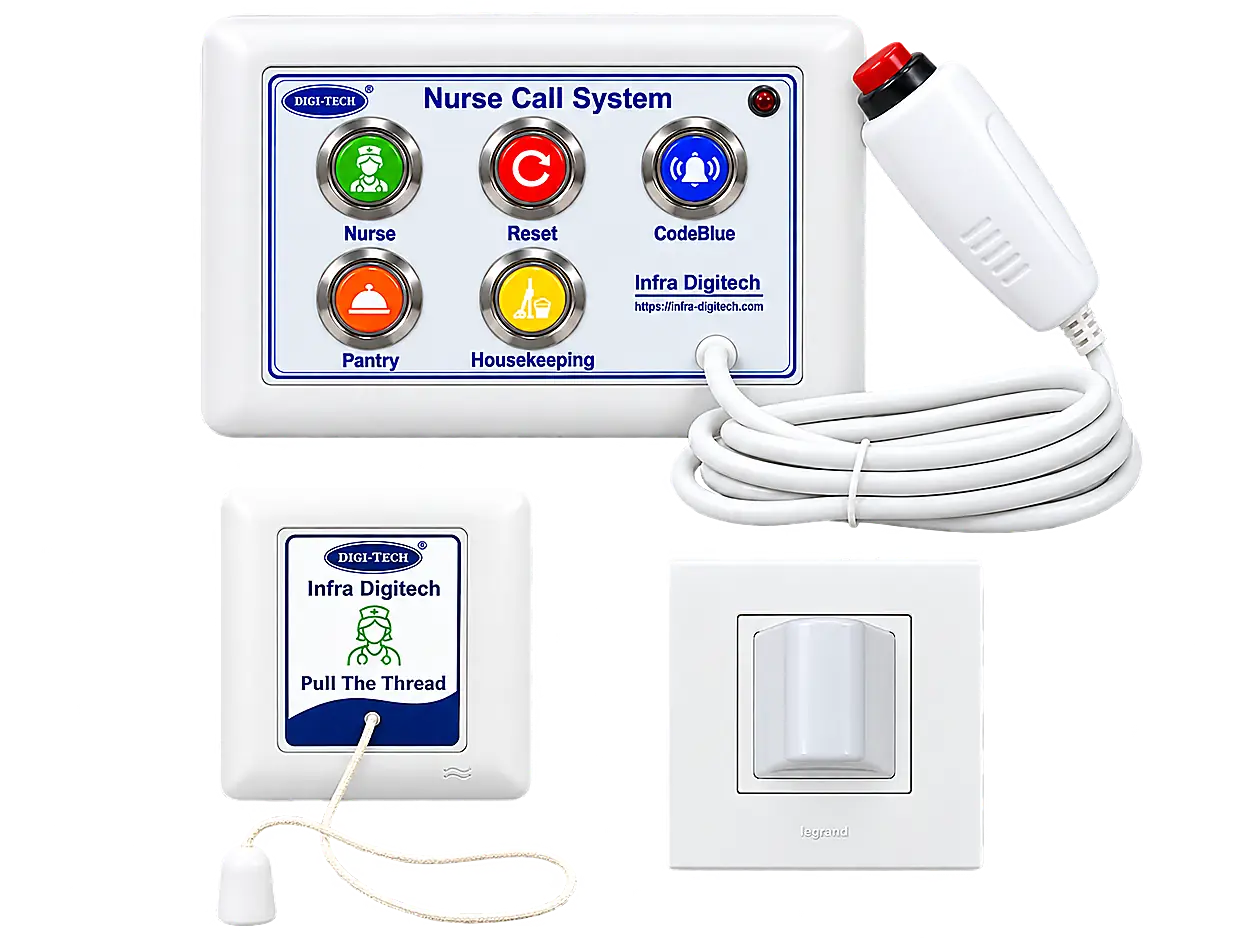
Infra DigiTech Pvt Ltd has named its nurse calling system range Signavanc™. The five models the company manufactures in Bengaluru — until now described by tier and by how they connect — carry one family name, with each model identified by what it actually does rather than by a number: Signavanc LR, Signavanc Air, Signavanc IP, Signavanc Ultra and Signavanc Lite.
Where the name comes from
Signavanc™ is a compound of two words: signal and advanced. The first half, signa, carries the signal — and behind it sits the Latin signum, meaning a sign or a mark, which is the root the English word signal grew from. The second half, vanc, carries the advance.
The choice was deliberate rather than decorative. A nurse call system does one thing that is not allowed to fail: it carries a signal from a patient who cannot get up, to a nurse who can. Everything else the range does — response reporting, escalation to a head nurse, colour-coded corridor indicators, HIS and EMR integration, mobile handsets — is built on top of that single transaction. Putting the signal in the name keeps the order of priorities visible, including internally: a feature that would compromise the reliability of the call itself is not a feature worth shipping.
The second half is the harder claim to earn, and it is meant narrowly. Advanced here does not mean the longest specification sheet. It means the engineering that has accumulated around that signal over twenty-five years of installing these systems in Indian hospitals — a self-healing radio mesh for buildings that defeat ordinary wireless, a star topology on structured cabling for wards where nothing may be shared, batteries that report their own level weeks before they matter, and a call that latches on screen until a nurse clears it rather than quietly timing out.
How to say it
Signavanc is pronounced SIG-na-vanc. It is one word, capitalised on the S only, and it is a trademark of Infra DigiTech Pvt Ltd.
What the name covers
The Signavanc™ range is five models across three ways of connecting. The decision between them is a question about the building rather than about the feature list, because the clinical essentials — a call point at every bed and patient-accessible washroom, toilet and shower pull-cords, corridor door indicators and a differentiated Code Blue — are on every model.
- Signavanc LR — long-range RF on a self-healing mesh, where each calling unit can relay for its neighbours. For thick masonry, basement levels and blocks separated by a courtyard.
- Signavanc Air — the same platform over Wi-Fi, on the hospital network or on one the system generates itself. The fastest way to bring an occupied ward live.
- Signavanc IP — a star topology on structured Cat 5/6 with fibre between hubs, giving every bed its own dedicated cable run. For new builds, full rewires and ICUs.
- Signavanc Ultra — an LCD nurse station, multi-colour indicators and centralised reporting on ordinary 4-core cable, for buildings where Cat 5/6 was never pulled.
- Signavanc Lite — a dot-matrix ward panel showing the exact room and bed, for wards where accurate identification at the lowest cost per bed is the requirement.
Full specifications for each sit on their own pages: the wireless nurse call system covers LR and Air, the wired nurse call system covers Ultra and Lite, and Signavanc IP has a page of its own. Hospitals running more than one of them across a campus are covered by the hybrid nurse call estate.
Turn Over Time, named on the console
Alongside the naming, the company is formally naming a capability the range has carried for some time: Turn Over Time, or TOT. It is the average interval between a patient pressing a call and a nurse clearing it, calculated by the system itself and shown on the nurse-station LCD next to the live calls rather than buried in a monthly export.
The calculation begins on the first day after installation and does not reset, so the figure on the screen is the ward's own accumulated history rather than a number assembled for a report. For a ward sister it answers, at a glance, the question a call log cannot: is this shift responding as quickly as the last one. The figure on the console is the live one, but it is not the only way to read it: the same data downloads as a report for whatever period is asked for — a shift, a week, a month, a quarter, or the range between two dates — so a ward can be compared against itself before and after a staffing change. For an administrator it gives a like-for-like comparison between wards, and a response-time record that was captured continuously rather than sampled during an audit week — which is the difference that matters when an NABH or JCI assessor asks how the claim was arrived at.
One exception
Signavanc Lite has no reporting module and therefore does not calculate Turn Over Time. Where measuring response is a requirement rather than a preference, that is the reason to specify Signavanc Ultra instead — it is the least expensive model in the range that records it.
Why name the range now
For most of the company's twenty-five years the systems were sold as tiers — advanced, standard, basic — which described the price rather than the building. That worked while a hospital bought one system. It stopped working once hospitals began running different models in different wards of the same campus, because a name that means only more expensive gives a procurement team nothing to decide with. Signavanc LR and Signavanc Air say what they do; a tier number does not.
Nothing about the hardware, the warranties, the service arrangements or the existing installations changes with the name. Systems already in wards keep their support and their AMC terms exactly as they are, and spares remain available under the same part numbers.
The name had to survive being read by a nurse at three in the morning and by a procurement officer comparing four quotations. Signal is what the system carries; the rest is engineering around it.
Compare the five Signavanc models — connectivity, capacity, reporting and Turn Over Time — on one page.
Explore the Signavanc rangeAbout Infra DigiTech
Infra DigiTech Pvt Ltd is an ISO 9001:2015 & CE certified, GeM-registered, MSME manufacturer of digital display systems, healthcare communication systems, queue & token management, GPS clocks, IoT devices and embedded software. Founded in 2001 and headquartered in Bengaluru, the company serves banks, hospitals, hotels, airports, factories and sports venues across India and worldwide.