
Queue management systems made in Bengaluru since 2001.
LED and LCD token systems for banks, hospitals, labs, airports, government offices and corporate floors — wired or completely wireless on our own network, with no subscription and no per-counter licence.
In 2001, A.N. Venkatesh integrated a token dispenser with our token display — one of India's first integrated queue management systems. When State Bank of India introduced single-window banking, we designed and supplied its QMS rollout in 2003–04, starting at SBI Kumaraswamy Layout. The purchase orders are still on record.
Choose your model
A queue management system replaces standing in line with holding a token. A visitor takes a printed token from a dispenser or tab kiosk, sits down, and is called to a counter by a display and a voice announcement when their turn comes — in order, fairly, with priority tokens called first. All three models below are designed and manufactured by us: displays, calling units, thermal printers and the paper rolls that feed them.
Two questions pick the model: can the site take a cable, and does the screen need names or just numbers?

LCD Wireless
Named queues · apps · flagship
Cardiology, X-Ray, a doctor's name — not just numbers.
- Tab kiosk, mobile calling & settings apps
- Call forwarding — one token, counter to counter
- SMS tokens, wait-time analytics, parallel displays
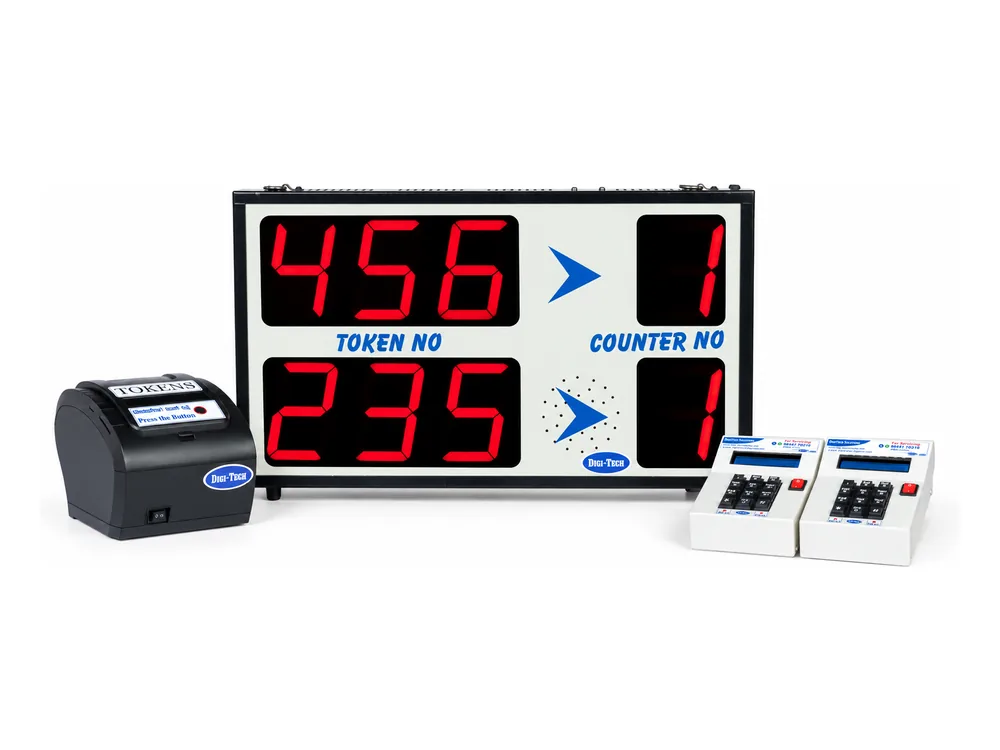
LED Wireless
Zero cabling · our own network
Plug and play — no client Wi-Fi involved.
- Runs on a network our router creates
- Connectivity status shown on calling unit and printer
- Up to 5 display lines across 9 counters
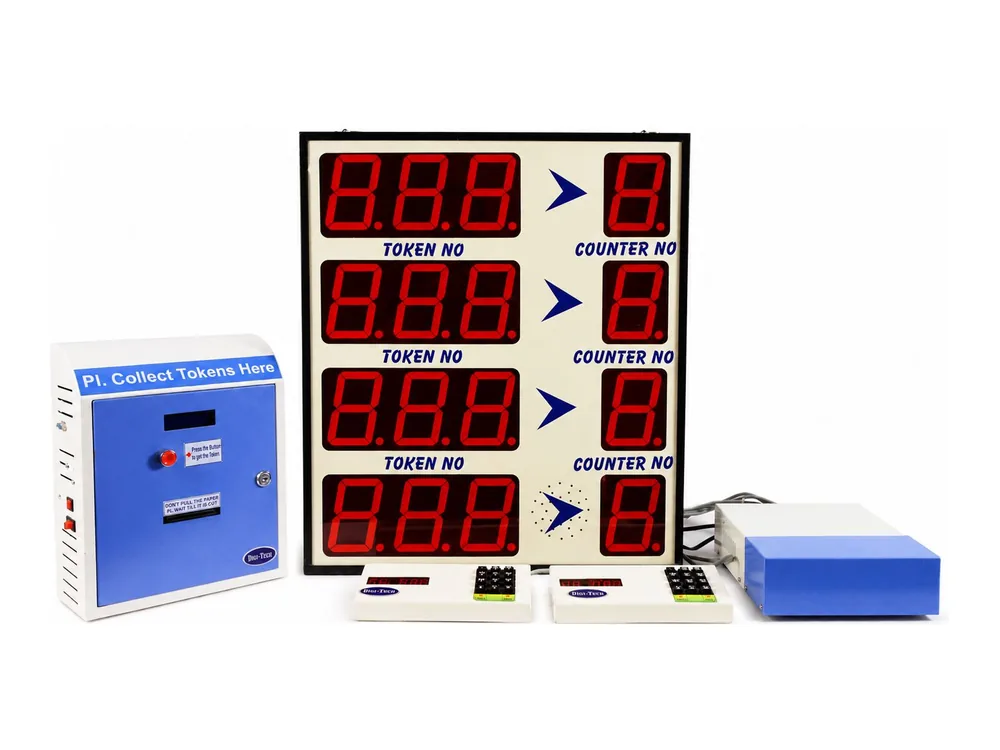
LED Wired
6-core cable · 7-segment display
Power in only two places, and no radio at all.
- Up to 8 display lines across 9 counters
- Power needed only at control box and printer
- Readable from 80–100 feet
All three models side by side
Model names link straight to full detail. Shared features — priority calling, queue merging, voice, token customisation — are listed below the table, once.
| LCD Wireless | LED Wireless | LED Wired | |
|---|---|---|---|
| Cabling | None | None | 6-core 14/38 multistrand |
| Network | Our own — no client Wi-Fi | Our own — no client Wi-Fi | — |
| Display | LCD — scrolling, 4-line, 6-line, constant or split screen | 7-segment LED, up to 5 lines | 7-segment LED, up to 8 lines |
| Counters | Configurable | Up to 9 | Up to 9 |
| Queues | 15 per screen, 30 on a swipe — configurable to 100 | 6 on our printer · 2 on POS | Up to 6 (our printer) |
| Queue names | Cardiology, X-Ray, doctor name, Passbook Entry… | Numbers only | Numbers only |
| Calling unit | 2×16 LCD + keypad, or mobile app | 2×16 LCD + keypad | 7-segment display + keypad |
| Mobile apps | Calling app + settings app | ||
| Call forwarding | Registration sends the token on to OPD, lab or billing | ||
| Missed-token recall list | On the display and in the app | ||
| SMS tokens | |||
| Reports & analytics | Token journey, average wait by queue and counter, peak-hour trends, downloadable | ||
| Parallel displays | |||
| Power needed at | Every unit | Every unit | Control box + printer only |
On LED Wired the cable is laid by your electrician to our specification — we do not undertake cabling. The POS printer option on the wireless models runs 2 queues and omits the printer status display; our own thermal printers carry 6 queue buttons, auto-cutting and a paper-end sensor.
Hardware you own, not a subscription
Much of what is sold as a queue management system today is a cloud platform: a monthly fee, a per-counter licence, and a service that stops issuing tokens when the internet does. That model suits some businesses. It does not suit a bank branch, an OPD or a government counter that must keep serving people through every outage, forever, at a known cost.
We build the other kind. You buy the hardware and own it. It runs entirely on site — the wireless models on a network our own router creates — so there is no recurring licence, no cloud dependency at the counter, and nothing your IT department has to adopt.
- No monthly platform fee
- No per-counter licensing
- Runs without internet
- Not on your Wi-Fi — on ours
- Serviced across India, since 2001
What every token management system here does, without being asked
Call it a queue management system or a token management system — these come standard on LED Wired, LED Wireless and LCD Wireless alike, except the one card marked for the model that carries it.
Priority calling
Also called preferential calling. A token taken at a senior-citizen or priority button jumps the line: the counter calls it first, automatically. The person who most needs the seat spends the least time out of it.
Automatic queue merging
Several counters can serve one queue, and queues can be merged when a counter closes for lunch or the day thins out — nobody stands in a dead line in front of an empty seat.
One keypad, one set of rules
The 3×4 keypad works identically across the range — * calls the next token, # recalls — so staff trained on one counter can sit at any other, in any branch, on any model. Tokens reset at 12 AM (configurable) and each queue runs its own serial range (1–100, 101–200…), so two people in one hall never hold the same number.
Voice in your customer's language
Token announcements in English and all Indian regional languages, on every model — with a built-in speaker and volume control on the calling unit, and an on/off switch for counters not in use.
The token is your letterhead
Date, time, type of service, token number, organisation name and contact number — printed on every token and customisable. Our own thermal printers cut each token automatically and sense the end of the paper roll.
Every token, measured
Every token is recorded — issued, called, served, by which counter, and how long the person waited. Reports download for any period, and the cut is built to what you want to see.
- Average wait time per queue and per counter
- The hours and days tokens are issued most
- Counter load, and week-on-week comparison
- Running average wait in the display footer


Anywhere people wait their turn
Hospitals & clinics
Registration to OPD to lab to pharmacy — call forwarding follows the patient.
See howBanks & finance
Teller, cash, passbook, loans — with senior citizens called first.
See howDiagnostic labs
Sample collection queues that hold up under NABL scrutiny.
See howAirports & transport
Check-in, verification and service counters at terminal scale.
Government & PSU offices
Citizen services with a fair, visible order of service.
Corporate & retail
Front desks, service centres and showrooms.
The details that show up during installation
What needs power
On LED Wired, power is needed at exactly two points: the control box and the printer. On the wireless models each unit takes a standard 220 V point through our own 5 A plug — no special electrical work anywhere.
Who lays the cable
LED Wired runs on ordinary 14/38 multistrand 6-core cable from the control box to the printer, calling units and display. Your electrician lays it like any other low-voltage run — we supply the specification and check the runs at installation.
Whose network it runs on
Ours. The wireless models run on a network our own router creates — we never touch your Wi-Fi, your IT team files no tickets, and an internet outage changes nothing at the counter.
The banks that built this product line, and the hospitals that followed











Before you specify
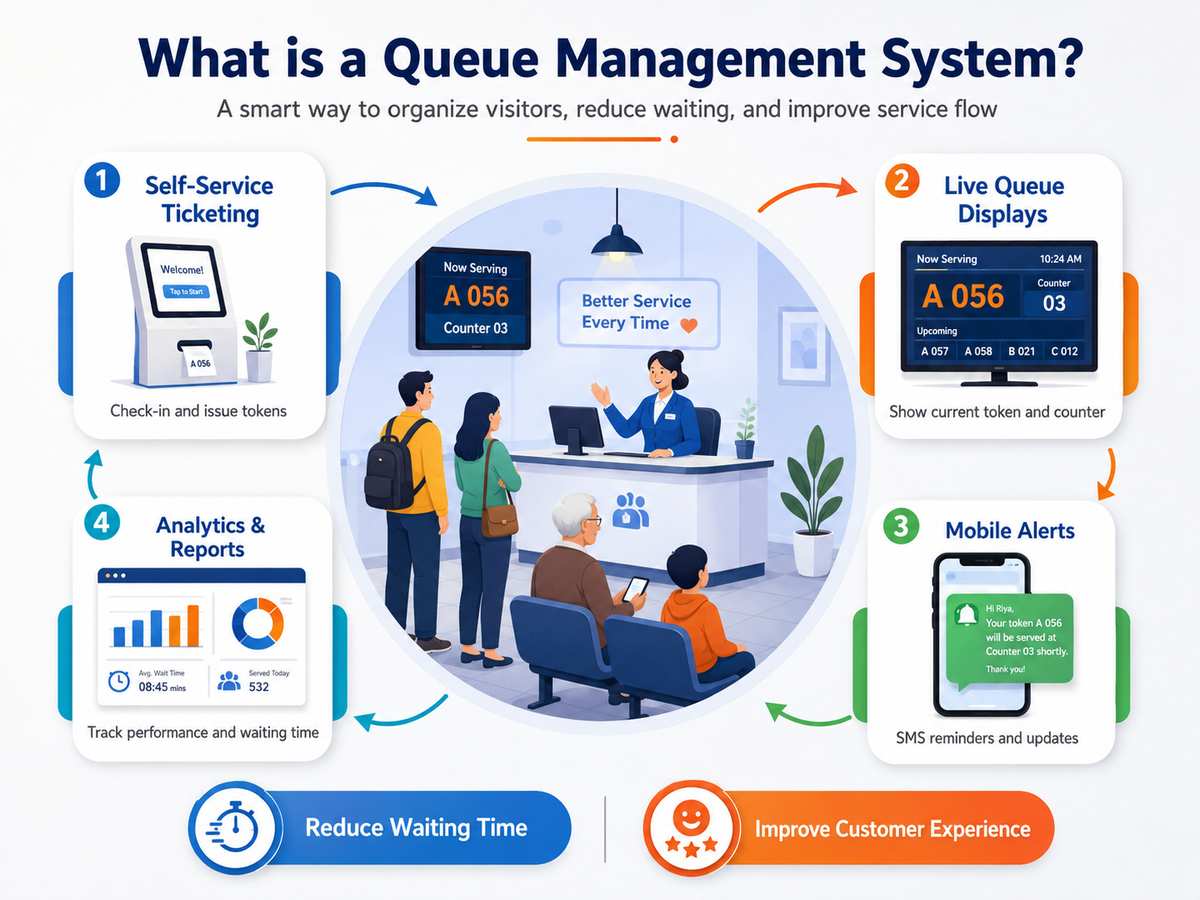
What Is a Queue Management System? How It Works, Types and How to Choose One in India
A queue management system replaces standing lines with tokens: customers take a number, sit down, and get called to a counter by display and voice. Here is the complete guide - the components, how the token flow actually works, the types from a simple doctor display to airport-scale systems, hardware vs software vs open source, and how to choose the right one.
Read the guide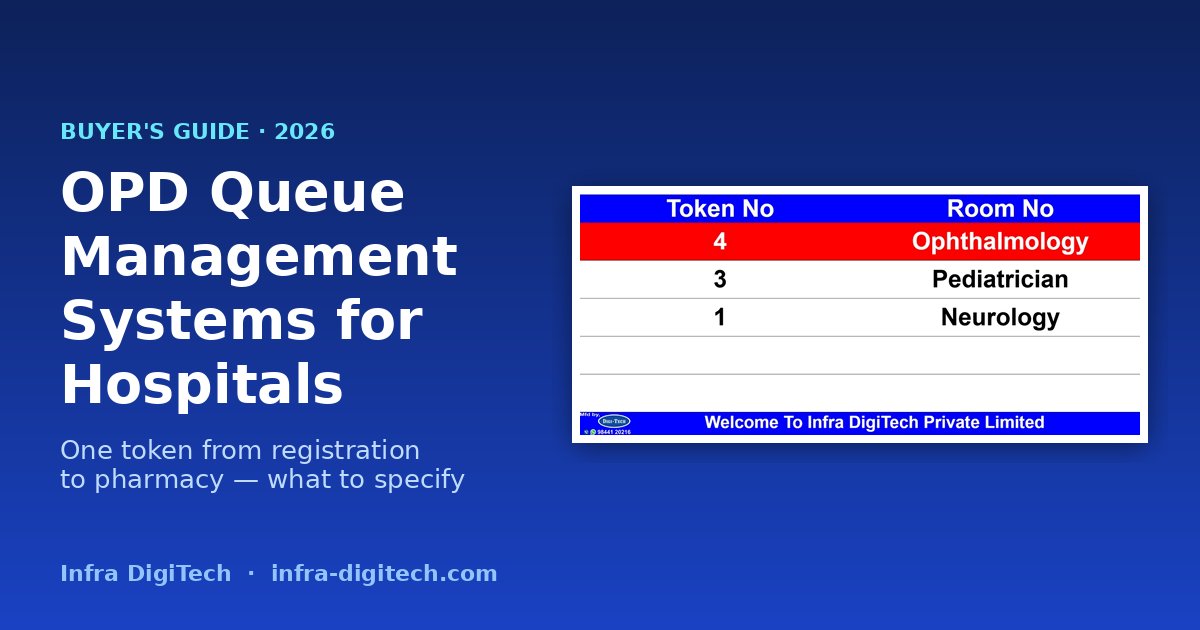
OPD Queue Management Systems for Hospitals: The 2026 Buyer's Guide
A single OPD visit means queueing four times — registration, consultation, lab, pharmacy — unless the token travels with the patient. What an OPD queue management system actually is, the twelve things worth specifying, when a 7-segment LED board is the smarter buy, and the waiting-time evidence a patient-experience review will ask you for.
Read the guide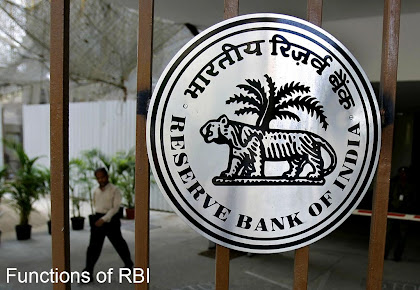
RBI Display Board Compliance and Queue Management for Indian Bank Branches: A Procurement Guide
RBI mandates interest-rate, forex and service-charge display at every branch. Queue management is a separate customer-experience choice, not a regulatory requirement. This guide separates the two clearly and gives a procurement checklist for each.
Read the guideQueue management — common questions
What is a queue management system?
A queue management system replaces standing in line with holding a token. A visitor takes a printed token from a dispenser or tab kiosk, sits down, and is called to a counter by a display and a voice announcement when their turn comes — in order, with priority tokens called first. It is also called a digital queue management system, electronic queue management system or token management system; the machine itself is often searched as a queue token machine.
Which queue management systems does Infra DigiTech make?
Three models, all manufactured in Bengaluru. LED Wired runs on ordinary 6-core cable with an up to 8-line, 7-segment display and needs power only at the control box and printer. LED Wireless runs with zero cabling on a network our own router creates, with an up to 5-line display and connectivity status shown on both the calling unit and printer. LCD Wireless is the flagship: named queues, a tab token kiosk, physical or mobile-app calling units, call forwarding, missed-token recall, SMS tokens, parallel displays and reports.
Should we choose the wired or wireless queue management system?
Choose LED Wired if the site can take a cable run and you want the fewest powered points — the control box and printer are the only two. Choose LED Wireless when cabling is impractical or the hall is already in service: it is plug and play on our own network. Choose LCD Wireless when the screen must show names rather than numbers — departments, doctors, services — or when you need call forwarding, apps, SMS tokens or reports. All three share the same keypad convention, priority calling and voice announcements.
Do we need Wi-Fi or an internet connection?
No. The wireless models run on a network created by our own router — we do not use your Wi-Fi, and no internet connection is required for the system to issue, display, announce or call tokens. Your IT team is not involved, and an internet outage has no effect at the counter.
Is there a subscription or per-counter licence fee?
No. You buy hardware and own it. The system runs entirely on site, so there is no monthly platform fee, no per-counter licensing and no cloud dependency for daily operation — which is the main difference between our systems and SaaS queue platforms.
How many queues and counters can it manage?
The LED models drive up to 9 counters, with up to 6 queues on our own thermal printer (or 2 queues on a POS printer). The LCD model is configurable: the screen shows 15 queues at once, 30 with a swipe, and can be configured up to 100 queues — we recommend 30 for ease of use. Different counters can also be merged into the same queue.
What is priority or preferential calling?
A dedicated token button — typically for senior citizens — whose tokens are automatically called to the counter first, ahead of the regular sequence. It is standard on all three models, and in banks it is the practical answer to the RBI's expectation of priority service for senior citizens and differently-abled customers.
Can the display show department or doctor names instead of numbers?
On the LCD Wireless model, yes. Queue names are set from the settings app on the tab — Cardiology, X-Ray, Paediatrics, a room number, a doctor's name, Passbook Entry, Deposit — along with each queue's token range, individual queue resets and the display's footer message, name and logo. The LED models show token and counter numbers only.
Can we get reports on waiting times and token volumes?
Yes, on the LCD Wireless system. It records the journey of every token — issued, called, served, by which counter and how long the person waited — and turns that into reports you can download for any period: average wait time per queue and per counter, the hours and days when tokens are issued most, how load shifted between counters, and how one day or week compares with another. The analytics are customised to what you want to measure. The LCD display can also show the running average wait time in its footer, calculated from the tokens issued since the counter opened that day. The LED models call tokens but do not report on them.
What does a queue management system machine cost in India?
It depends on the model and the counting: how many counters, queues, displays and printers, and whether you want the tab kiosk, POS printing or parallel displays. A two-counter LED setup and a ten-counter LCD hospital deployment are very different machines. Send the enquiry form with your counter and queue count and we return a specified quotation within one business day.
Do you install and service queue systems across India?
Yes. We design and manufacture in Bengaluru and install and service across India through our own engineers and channel partners, with AMC plans — and we export to the GCC, Southeast Asia and Africa. The line began in 2001, when we built one of India's first integrated queue management systems and supplied State Bank of India's single-window rollout in 2003–04.
Specifying a queue system?
Tell us your counters, queues and site — we reply within one business day with a specified quotation, from the company that built India's first.