
LED wired queue management system.
One 6-core cable ties the whole token management system together, and only the control box and the printer need a socket. Up to eight lines of tokens and counters, readable at a hundred feet, with no network anywhere in it.
When a cable is the simplest answer
A building under fit-out already has electricians pulling cable through the false ceiling. Adding one more run while they are up there costs almost nothing, and it buys a token system with no radio to interfere with, no network to maintain and no unit hunting for a socket. That is the whole argument for this model, and it is a good one.
It is also the answer for older buildings — a bank branch in a 1980s block, a clinic in a converted house — where the counters are in place but the sockets are not. Here the display and every calling unit are fed down the cable, so the electrical work stops at two points.
What you give up is names on the screen. A 7-segment display shows numbers, and numbers are enough for most bank counters — but not for an OPD where the token has to say which department it is for.
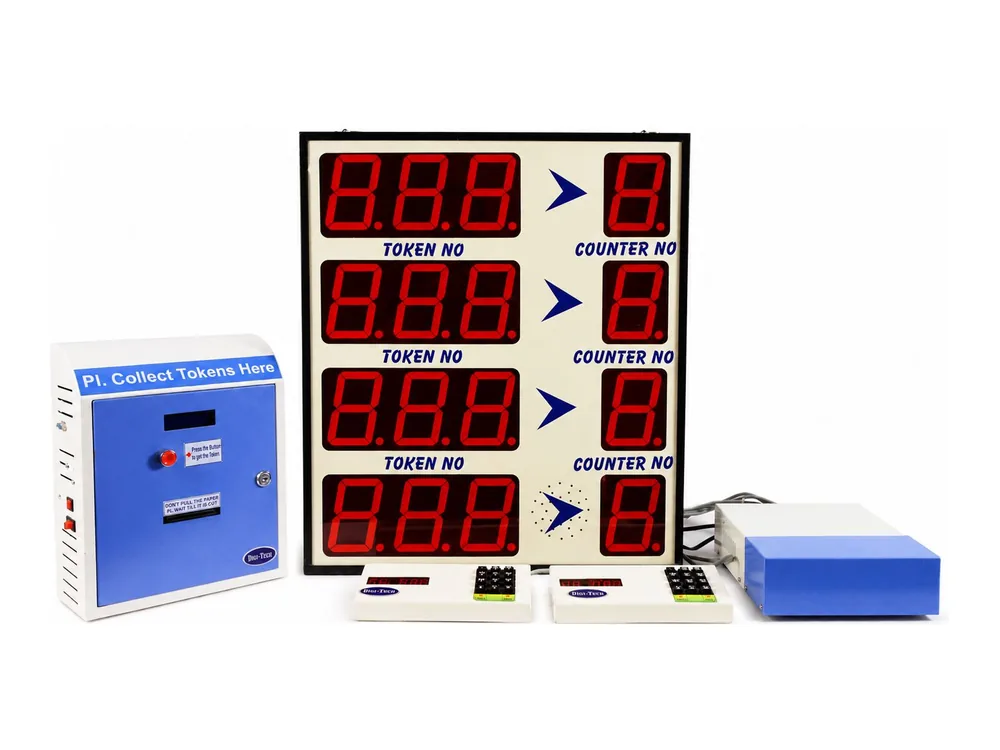
Four parts on one run of cable
The control box is the middle of the system: the printer, every calling unit and the display all connect back to it, and it is the only part that needs to be told anything about your counters.
- 1
The visitor takes a token
Our thermal printer stands at the entrance with up to six queue buttons on its face. One press prints the token — organisation name, service, date, time and number — and the cutter takes it off the roll.
- 2
One 6-core cable carries everything
A single 14/38 multistrand run links the control box to the printer, every calling unit and the display. No radio, no router, no IP address, nothing for IT to approve.
- 3
The counter calls, the board shows it
NEXT calls the following token, CALL repeats it, or the clerk keys any number to call it out of turn. The board shows the token against the counter and the announcement says it aloud.
- 4
Power in two places only
The control box and the printer need a 220 V point. Calling units and the display are fed down the same cable, which is what makes this model fit an old building with few sockets.
What arrives on site
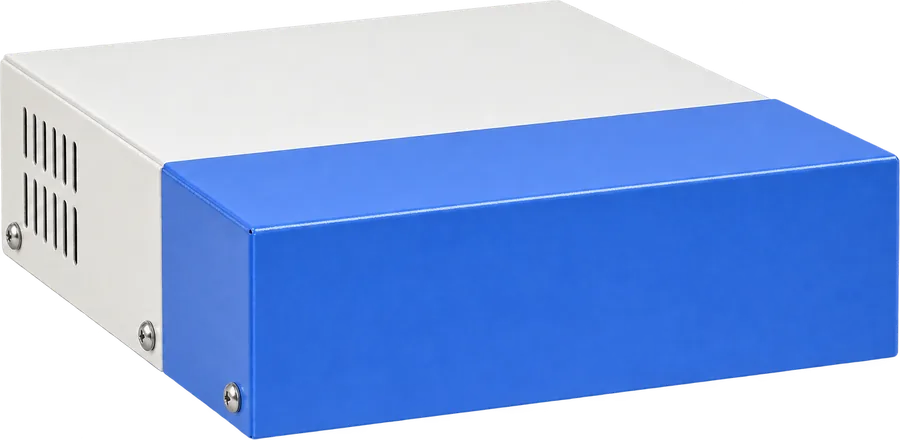
The control box
The hub of the system. The printer, the calling units and the display all terminate here, and the counter-to-queue mapping lives here — so a counter can be moved from one queue to another without touching a single unit on the floor. One of the two parts that needs a socket.
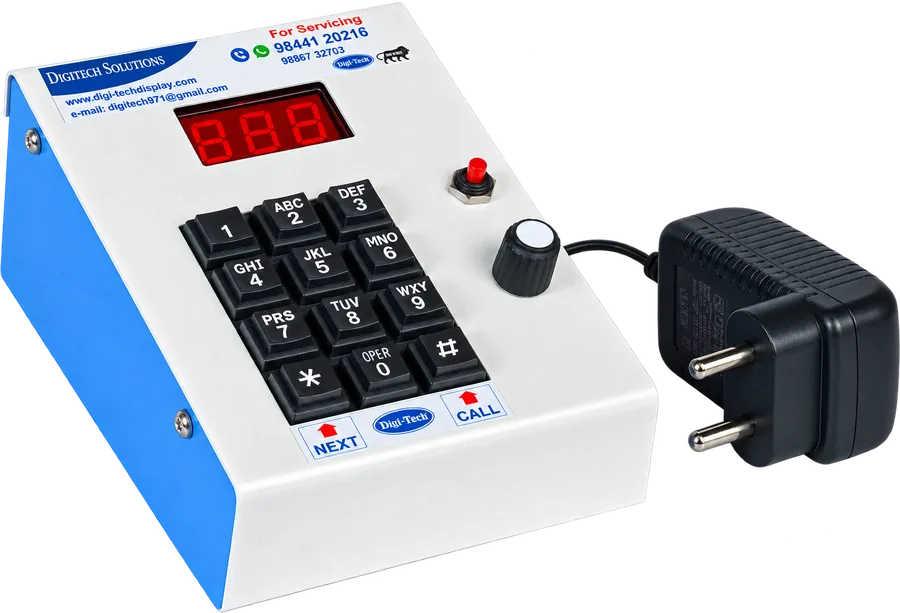
The calling unit
Its readout shows the token this counter is serving and how many are still pending in that queue, so a clerk can see the load without asking anyone. NEXT calls the following token, CALL repeats it, and keying a number calls any token out of turn.
- 7-segment readout — present token and pending count
- Next, recall and random calling from the keypad
- Built-in speaker with volume control
- On/off switch for a counter not in use
The printer and the token
Our own thermal printer, manufactured here, carries up to six queue buttons on its face — so a hall with several lines needs no kiosk and no screen. It cuts every token automatically and senses the end of the roll before it strands a queue.
- Six queue buttons for six queues
- Automatic token cutting
- Paper-end sensor · 55 mm / 55 GSM rolls
- Token reset at 12 AM, configurable
More on dispensers and rolls on the token dispenser page.

Numbers, big enough to read from the back
Bright bar-type 7-segment digits in red, sized for the room. It is the least fashionable display we make and the one customers replace least often: there is no operating system in it, nothing to update, and it stays legible through the glare of a glass-fronted branch at four in the afternoon.
Token and counter
Three digits for the token number, one for the counter — 104 → 3, the format an Indian bank hall already reads without instruction.
Up to 8 lines, 9 counters
One line per counter. A two-counter clinic takes a two-line board; a branch hall takes eight, configurable for up to nine counters.
80–100 feet, 120°
Bright bar-type 7-segment digits with a wide viewing angle, so the board reads from the back of the hall and from the side, not only head-on.
Called out loud
Voice announcement in English and all Indian regional languages, through the calling unit's built-in speaker, with volume set at the counter.
The same boards are sold on their own as a token display system where a site already has its own calling arrangement, and the dispenser on its own as a token dispenser.
The cable is your electrician's job
We supply the system and commission it. We do not pull cable, and a supplier who promises to and then sub-contracts it on the day is how a fit-out slips a week. Your electrician lays one run to our specification — ordinary 6-core cable, not something you buy from us — and we take it from there.
What the site has to provide

- 6-core 14/38 multistrand — ordinary cable, available in any electrical market in India
- Laid by your electrician to our specification; we do not undertake cabling
- Control box to printer, calling units and display, in one run
- No network cable, no router, no Wi-Fi password, nothing on your LAN
Included on this model, and on both wireless ones
None of this is an upgrade or a licence. It is how every queue system we build behaves.
Priority calling
Also called preferential calling: a token taken at a senior-citizen or priority button is called to the counter first, automatically.
Automatic queue merging
Several counters can serve one queue, and queues merge when a counter closes — nobody stands in a dead line in front of an empty seat.
Midnight reset, own serial ranges
Tokens reset automatically at 12 AM, configurable. Each queue can run its own range (1–100, 101–200…) so two people never hold the same number.
Voice in your language
English and every Indian regional language, with a built-in speaker, volume control and an on/off switch for a counter not in use.
The token is your letterhead
Date, time, type of service, token number, organisation name and contact number — printed on every token and customisable.
Hardware you own
No subscription, no per-counter licence, nothing in the cloud. The system runs on site and keeps running whether your internet does or not.

Same wiring, one button
Not every counter needs a keypad. This version of the same wired system uses a single-line display and a compact calling unit with one NEXT button — the clerk presses it, the next token is called, and that is the whole interaction.
What it gives up is random calling and recall by number: tokens can only be called in order. For a two-counter clinic, a small office or a stores window where nobody ever needs to reach back for a missed token, that is a saving rather than a loss.
- Single-line token and counter display
- NEXT-only calling unit — no keypad
- Same dispenser, cabling and voice announcement
- Lowest cost per counter in the range
LED Wired in numbers
| Display | 7-segment bright bar type, up to 8 lines — one line per counter |
|---|---|
| Format | 3-digit token number + 1-digit counter number (104 → 3) |
| Readable at | 80–100 feet, 120° viewing angle |
| Counters | Configurable for up to 9 |
| Queues | Up to 6 — six queue buttons on the face of our thermal printer |
| Queue names | Numbers only — a 7-segment display cannot form words |
| Calling unit | 7-segment readout showing the present token and pending tokens, 3×4 keypad, NEXT and CALL, built-in speaker, volume control, on/off switch |
| Calling modes | Next token, recall, and random calling — key any token number directly |
| Printer | Infra DigiTech thermal printer — automatic token cutting, paper-end sensor, 55 mm / 55 GSM roll |
| Token print | Date, time, type of service, token number, organisation name and contact number — customisable |
| Cabling | 6-core 14/38 multistrand, laid by your electrician to our specification |
| Architecture | Control box to printer, calling units and display |
| Network | None. No Wi-Fi, no router, no internet, nothing on your LAN |
| Power | 220 V AC at the control box and the printer only |
| Announcement | English and all Indian regional languages |
| Token reset | Automatic at 12 AM, configurable; per-queue serial ranges |
| Standard features | Priority / preferential calling, automatic queue merging |
When this is not the model to buy
Two situations where the cable that makes this model good is the reason to choose another one:
The hall is already in service
Nobody wants a cable tray over a working banking hall, or a false ceiling opened in a live OPD. LED Wireless is the same display and the same keypad with no cabling at all, on a network our own router creates.
LED WirelessThe screen has to say a name
Cardiology, X-Ray, Passbook Entry, a doctor's name. Seven-segment digits cannot form words, so a hospital OPD — and anything needing call forwarding, apps or wait-time reports — belongs on the LCD Wireless model.
LCD WirelessSee the full comparison of all three models side by side.
LED Wired — common questions
What cable does the LED wired queue management system need?
A 6-core 14/38 multistrand cable — ordinary cable available in any electrical market in India, not a proprietary one we sell at a markup. One run links the control box to the printer, the calling units and the display. Your electrician lays it to our specification during the fit-out; we do not undertake cabling ourselves, and we would rather say so before the order than after it.
How many power points does the token management system need?
Two: one at the control box and one at the printer. Every calling unit and the display run off the cable. On the wireless models each unit needs its own 220 V point, which is the single biggest reason an old building with few sockets ends up choosing this model.
Does it need Wi-Fi or an internet connection?
No — and not merely in the sense that it works offline. There is no network in this system at all: no router, no Wi-Fi password, no IP address, nothing on your LAN for IT to review or maintain. It is wire and current, which is why bank branches with locked-down networks specify it.
Can the display show department or doctor names?
No. A 7-segment display forms numbers, not words — it shows the token and the counter, 104 → 3. If the screen has to say Cardiology, X-Ray or a doctor's name, that is the LCD Wireless model, which uses an ordinary television as the display.
How many queues and counters does it handle?
Up to nine counters, with up to eight lines on the display, and up to six queues on our thermal printer — the six queue buttons sit on the face of the printer, so a visitor presses the one they need. Each queue can run its own serial range, so two people in the hall are never holding the same number.
What does the LED wired queue management system cost?
It is quoted per site, because the count decides it: how many counters and queues, how many display lines, and the size of the board for the room. Cabling is your electrician's scope, so it does not sit in our quotation. Send your counter and queue count through the contact form and a specified quotation comes back within one business day.
Counting counters?
Tell us how many counters and queues the hall runs and where the board goes. A specified quotation comes back within one business day, with the cable specification your electrician needs.