
Walk into any busy OPD at nine in the morning and you can watch the same patient join four different lines in one visit: registration, the consulting room, the lab, the pharmacy. Each line has its own crowd, its own arguments about who came first, and its own nurse being interrupted with the same question — how long will it take? An OPD queue management system replaces all of that with one token, a screen that calls patients by room or department name, and a number nobody in the hall can argue with. This guide covers what the system actually is, what to specify, where hospitals overbuy, and the evidence it should leave behind for a patient-experience review.
What is an OPD queue management system?
An OPD queue management system is a token system built for outpatient departments. The patient takes a printed token at registration or from a self-service kiosk, sits down, and is called to a consulting room by a display and a voice announcement — in the order tokens were issued, with senior-citizen and priority tokens called first. In a hospital it is also searched for as a patient queue management system, a hospital token display system or an OPD token system; the machine at the door is often called a token dispenser or token kiosk. The parts are simple: a dispenser or kiosk that issues tokens, one or more displays, a calling unit or mobile app at each room, and a small server that records every token.
The part that separates a hospital system from a bank-counter system is what happens after the first call. A bank customer is served once and leaves. An OPD patient moves — consultation to phlebotomy to X-ray to pharmacy to billing — and a system that cannot move the token with them has only solved a quarter of the problem.
The real problem: one visit, four queues
Map a routine OPD visit and the waiting multiplies quietly. The patient queues to register, queues outside the consulting room, queues at sample collection or imaging if the doctor orders a test, then queues at the pharmacy — and sometimes at billing after that. Four or five separate waits, each restarting from the back of a new line, each invisible to the hospital because nobody measured any of them.
Token forwarding is the feature that collapses this. Registration issues one token and forwards it to the consulting room; the room forwards it to the lab; the lab to the pharmacy. The patient keeps one number for the whole visit and is called at each stop in turn — never rejoining a line, never taking a second token. Just as usefully, every hop is recorded, so the hospital finally sees the whole journey: not 'the pharmacy wait is 12 minutes' but 'a visit that touches four departments takes 68 minutes, and 31 of them are at sample collection.'
Ask this in the demo
Have the vendor issue a token, forward it across three counters and then show you that token's journey in the report — issue time, every call, every hop, total wait. If the system cannot show the journey of one token, it cannot show you the journey of forty thousand.
What the screens should show — names, not just numbers
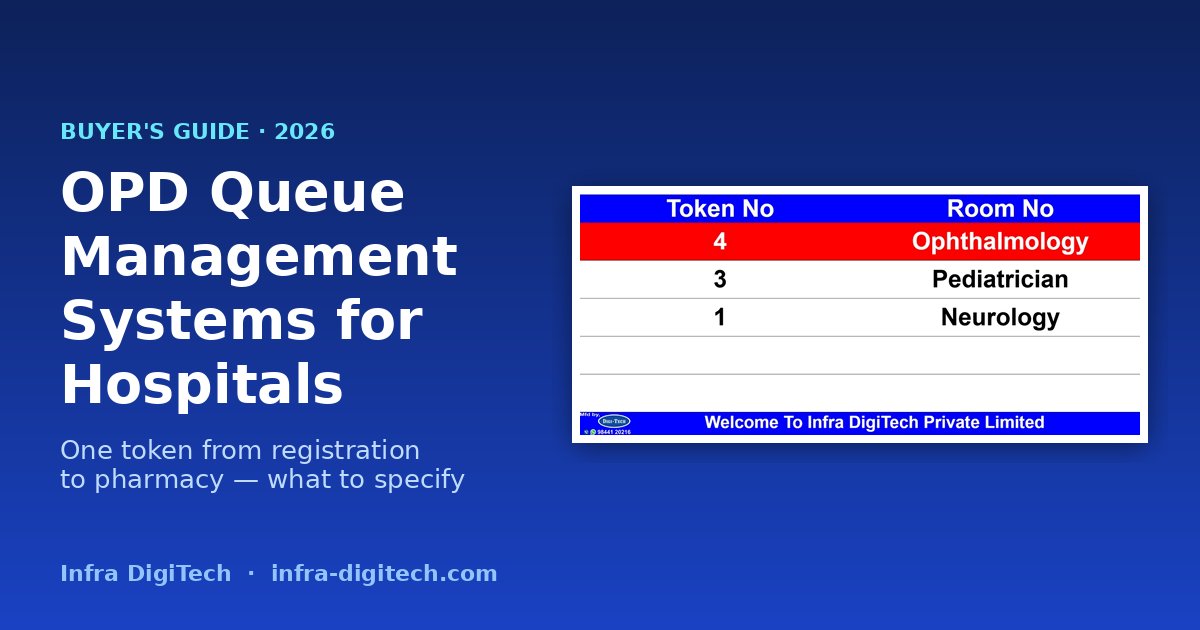
A hospital corridor has rooms, facilities and doctors, not numbered counters. On an LCD platform like our LCD Wireless queue management system, the queue name is free text — Ophthalmology, Pediatrician, Phlebotomy, X-Ray, or an individual doctor's name — shown beside the token and spoken in the announcement, in English or any Indian regional language. The token being called sits in a highlighted row, and the footer can carry two things worth insisting on: a scrolling line the hospital writes itself, and the live average waiting time, calculated from the day's own tokens. A hall that can see '8 minutes' stops asking the nurse, and a hospital that publishes its waiting time tends to manage it.
Names change more often than buyers expect — visiting doctors, clinic days, a room becoming an ECG room. The queue names, serial ranges, footer line and department list should be editable by your own staff from a settings app, not by a service call to the vendor.
Priority calling: seniors and emergencies, by rule
Every OPD has a preference policy for senior citizens, differently-abled patients and urgent cases. The question is whether it lives in a staff member's judgement — argued about in front of a full waiting hall — or in the system. A priority button on the dispenser issues a priority token that is automatically called ahead of the general queue. The rule becomes visible, nobody at the counter has to defend it, and the report shows exactly how many priority tokens were served and how long they waited.
The specification checklist
Twelve items cover almost everything that matters in an OPD tender. The first six are patient-facing; the rest are the plumbing that decides whether the system is still working in year five.
- Named queues in free text — department, facility, room or doctor — shown on the display and spoken in the announcement.
- Token forwarding between departments, with every hop recorded; missed-token recall for the patient who stepped out.
- A priority button for senior citizens and emergencies, called first automatically.
- Live average waiting time on the display, calculated from the hospital's own tokens.
- Voice announcement in your regional language, with per-room volume control and an off switch for rooms not in session.
- SMS tokens for attendants who wait in the canteen or car park, alongside the printed token.
- Parallel displays off one system — OPD corridor, lab waiting area, pharmacy, first floor — each with its own queue set.
- A network of its own: the system should run on the vendor's router, not hospital Wi-Fi, and keep issuing and calling tokens through an internet outage.
- No patient data — a token should be a number, with no name, UHID or diagnosis anywhere in the queue system.
- Reports on an on-site server, downloadable as CSV for any date range, with cloud or HIS/HMS integration as an option rather than a dependency.
- A thermal printer with auto-cut and a paper-end sensor — the roll running out mid-morning is the most common failure in the category.
- Hardware you own, with no per-counter licence or compulsory subscription, and spares committed in writing for the life of the model.
The subscription question
A cloud-only queue system means the OPD queue depends on the hospital's internet connection, the vendor's servers and next year's renewal invoice — and it usually means patient footfall data sits outside the building. Ask where the system runs, what stops working when the internet fails, and what the hall looks like on the day a subscription lapses. The answers should be: on site, nothing, and the same as any other day.
LCD platform or LED board? Both belong in hospitals
Not every queue in a hospital needs names on a screen. The LCD platform earns its cost where the patient must be routed — the OPD corridor, multi-department labs, anywhere forwarding, named rooms, SMS tokens and waiting-time reports matter. A 7-segment LED board — our LED Wireless with no cabling at all, or LED Wired on ordinary 6-core cable — shows token and counter numbers in digits readable the full length of a hall, costs less, and is exactly right for a pharmacy counter, a billing queue or a single-department sample-collection room. Many hospitals run both from the same family: the LCD system in the OPD, LED boards at pharmacy and billing. A single-room clinic needs neither — a standalone token display is the honest recommendation there.
The reports: what a patient-experience review will ask for
NABH and internal patient-experience reviews ask about waiting times, and most hospitals answer with an estimate. A queue system answers with a record: every token's issue time, call time, total wait and route, plus averages by department, the longest wait of the day, footfall by hour and day, priority-token service times, and month-on-month comparison. The system does not certify anything — no queue system does — but it replaces 'we believe waiting is reasonable' with a CSV that shows it, which is the difference between an assurance and evidence.
What actually drives the cost
Vendors quote OPD systems site by site because the price is driven by counts, not by the software: how many departments and rooms, how many screens and where, kiosk or push-button dispenser at the door, how many calling units versus the mobile app, and whether reports need to reach a hospital cloud or HIS. Two things keep lifetime cost down more than any discount: hardware the hospital owns outright, and consumables that are ordinary — a standard thermal roll with an end sensor, not a proprietary cartridge.
Quick answers
Can one token really take a patient from registration to the pharmacy?
Yes — that is token forwarding, and it is the single feature that most changes an OPD. Each department forwards the token to the next; the patient is called at every stop on the same number, and every hop is timed.
Does an OPD queue system need the hospital's Wi-Fi or HIS?
It should need neither. A well-built system creates its own network with its own router, holds no patient data, and treats HIS/HMS or cloud reporting as an optional integration — so hospital IT has nothing to secure and an internet outage changes nothing at the counter.
How many departments should go on the kiosk?
Fifteen fit on one screen and thirty across a swipe; systems configure to a hundred, but past thirty a patient spends longer finding their department than they would have spent in the line. Keep the kiosk short and map rooms flexibly behind the department names.
We build the LCD Wireless OPD platform and the LED boards beside it, in Bengaluru, and both are running in hospitals and laboratories today — one token from registration to pharmacy, with the average wait on the screen.
See the hospital & OPD queue management system