
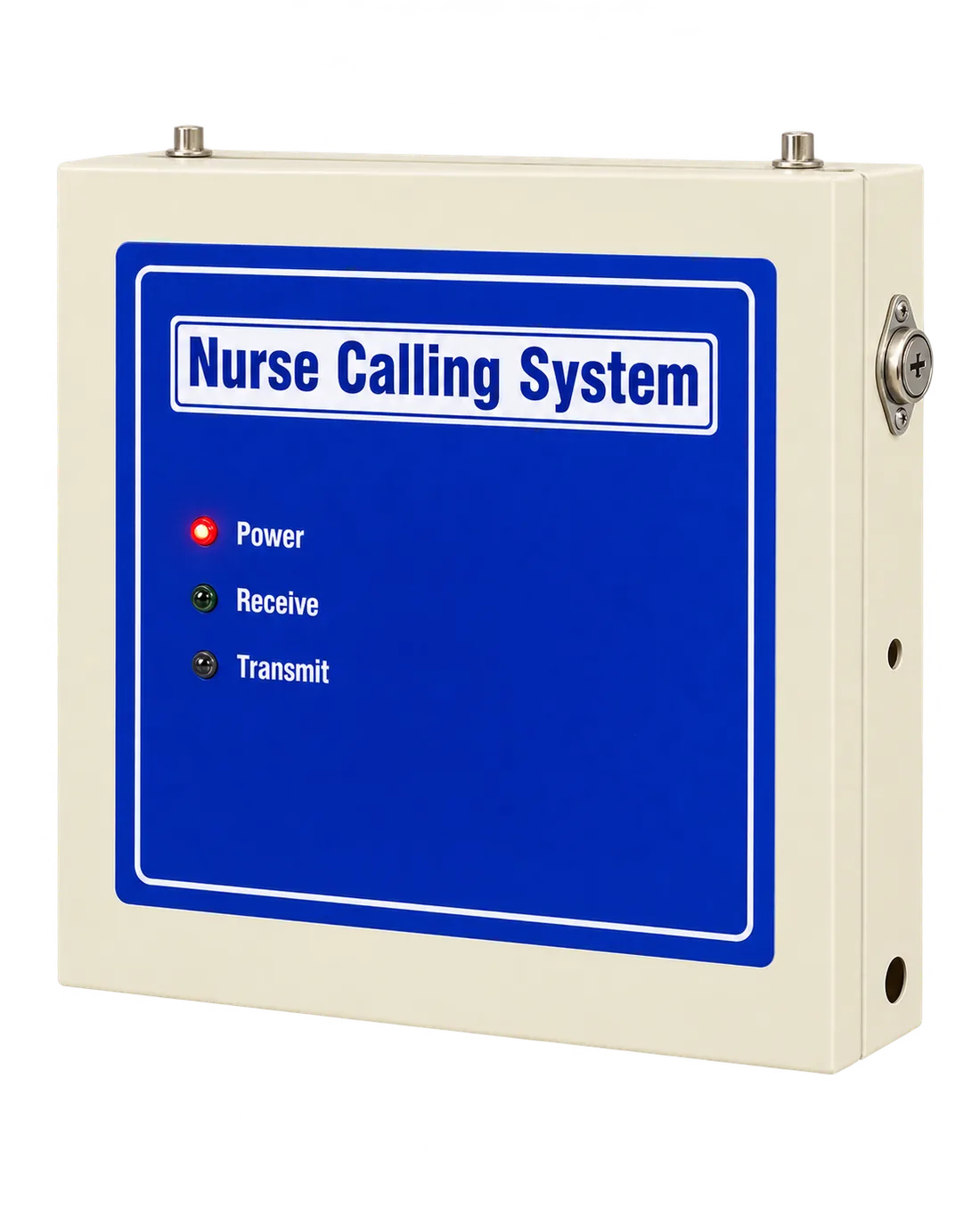
Send a nurse call enquiry to five companies in India and you will hear back from five suppliers. Far fewer than five of them made the product. The category is crowded with distributors and brand-holders rather than manufacturers, and their quotations can look almost identical to a maker's — same feature list, same certifications page, sometimes the same photograph. The difference does not show up on day one. It shows up in year six, when a bedside unit fails and you need one part, or when the ward layout changes and the console has to be reconfigured. This is how to tell which kind of company you are dealing with, before you sign.
Three kinds of company will answer your enquiry
Nurse call systems in India are supplied by a mix of domestic manufacturers and imported brands, and between you and either of them there is very often a third party. Put three quotations side by side and you can sometimes see it: the same product photograph, the same specification table, three different letterheads. That is not evidence of anything dishonest — it is simply what a distribution market looks like. But it does mean the company quoting you and the company that built the product are frequently not the same company, and none of the paperwork you have been sent will tell you that. None of the three kinds is inherently wrong to buy from. They fail differently, and that is the part worth understanding.
- The manufacturer designs the boards, writes the firmware and assembles the units. Ask a technical question and it goes to the person who made the decision. Customisation is a scheduling question rather than a request to a foreign principal. The risk is coverage — a maker may have no service presence in your state.
- The importer or brand owner holds a foreign brand for India. The hardware is usually good and the documentation excellent. Firmware, spares and any change to how the product behaves depend on a manufacturer in another country and another time zone, on their roadmap, at import prices and import lead times.
- The reseller or systems integrator buys from either of the above and sells it on with installation. A good one is genuinely valuable — they carry several brands, they know your city, and they take responsibility for the whole floor. But they cannot change the product, and their spares depend on whoever they bought from still stocking it.
Five questions that reveal which one you are talking to
Ask these in the first meeting. None of them is confrontational, and the answers separate the three cases quickly.
- 1Where is the PCB assembled, and can I see it? A manufacturer will show you the board and usually invite you to the factory. Anyone else will change the subject to certifications.
- 2If we need a change to how a call escalates, who makes that change and how long does it take? A maker answers in weeks and gives you a name. An importer answers with a support ticket to a principal. A reseller answers that it is not possible.
- 3Who physically installs and commissions it — your own engineers or a subcontractor? Then ask who I call at 2 a.m. in year three.
- 4How long will spares be available for this exact model, and is that in writing? The honest answer is a number of years. An evasive answer here is the single most useful signal you will get.
- 5Show me three installations of this exact model, one of them at least five years old. New products have no service history; the five-year-old site is the one that tells you the truth.
The question nobody expects
Ask where the product is manufactured, and then ask for it in writing on the quotation. A maker states it without hesitation. A supplier reselling somebody else’s hardware — imported or domestic — will usually answer with a certification, a brand name or a country of origin for a component rather than a plain answer about who assembled the unit. You do not need us to tell you what the market looks like. Ask five suppliers this one question and you will have your own answer by the end of the week.
If you only ask one
Ask the spares question. Everything else — price, feature list, certification — is verifiable on paper. How long somebody will keep making a part for a product they have already sold you is a commitment, and the way a supplier handles that question tells you what kind of company they are.
What actually breaks, and why it matters who made it
Nurse call systems rarely fail dramatically. They fail one unit at a time, years after the invoice, and the question is never whether something breaks — it is what happens next. Three situations separate suppliers, and all three are worth putting to a vendor before you buy rather than after.
- A single bedside unit dies in year four. If the model is current, this is a part. If it has been superseded — and consumer-electronics cycles are short — the replacement may not speak to your console, and a one-unit fault becomes a ward-level replacement. Ask what happened the last time a model in their range was superseded, and what existing customers were offered.
- The ward is reconfigured. Beds are renumbered, a room becomes a store, two wards merge. On a system built by the people selling it, this is a configuration change. On a badged product it can require the principal’s software and, occasionally, a site visit billed as a project.
- A requirement changes above you. NABH tightens, the hospital adds a Code Blue protocol, an insurer asks for response-time evidence. A maker can add what is missing. A reseller can only tell you which other product to buy instead — which means buying the ward twice.
None of this argues for paying more. It argues for asking the year-six question during the year-one meeting, when you still have leverage.
What only a manufacturer can do
- Change the product for your ward — call types, escalation rules, colour mapping, the wording on the console, an extra language for voice announcements.
- Keep making a discontinued part, because the decision to keep making it is theirs.
- Quote without an importer's margin and an integrator's margin stacked on top of the same hardware.
- Answer a firmware question in engineering terms rather than forwarding it.
- Mix models across an estate — wired in the new block, wireless in the ward that cannot close — and still consolidate reporting, because one company built both.
The engineering questions a badge cannot answer
You do not need to be an engineer to use these. Ask them and listen for whether the answer comes back as a design decision with a reason, or as a specification read off a sheet. A company that made the product explains why it chose something. A company that did not will describe what it does.
- How is electrical noise handled on the data line? Hospitals are electrically hostile — lifts, chillers, autoclaves, generator changeovers. Noise suppression on the line is a deliberate design choice, and a maker will name what they use and why.
- Star or daisy-chain? On a star, every call point has its own run to the hub, so one bed’s fault cannot take out its neighbours. Daisy-chained wiring is cheaper to install and fails in groups. This one decision explains more about long-run reliability than any feature list.
- Does a call latch until a nurse clears it, or can it time out? A call that clears itself is an audit problem and a patient-safety problem. Ask to see it — press a call, walk away, and come back in ten minutes.
- What is the input voltage range, and what happens on a generator changeover? A wide 110–240 V input with suppression built in is the difference between a system that rides through Indian mains and one that reboots during a power event.
- On wireless: what happens when two systems overlap, and what happens when a unit stops reporting? Frequency-hopping and a unit that shows as missing rather than silently disappearing are both design choices somebody made on purpose.
- What is the enclosure, and where will it be mounted? A washroom pull-cord and a corridor indicator live in humidity and cleaning chemicals for a decade. Ask about the material, not the colour.
Why this works as a test
These are not trick questions and there is nothing wrong with a distributor who cannot answer them — it is not their job. But the answers tell you, in about ten minutes and without anybody having to be evasive, whether the company in front of you holds the design or holds a price list.
What a reseller often does better
This is the part most manufacturer-written guides leave out, and leaving it out is how you end up with the wrong supplier for honest reasons.
- Local presence. A reseller two hours from your hospital will reach you faster than a factory eight hundred kilometres away, whatever the SLA says.
- One contract for the whole floor — nurse call, fire panel, CCTV, access control — with one company accountable for the integration.
- Multiple brands, so they can genuinely compare rather than defend one product.
- If your requirement is standard, your ward is straightforward and you will never need the product changed, the integrator's convenience may be worth more to you than the maker's flexibility.
The question is not which type is better. It is which failure you would rather live with: a maker who is far away, or a supplier who cannot change the product and does not control the spares.
Reading the quotation
- Insist on per-point-of-care pricing. A single system price makes two vendors incomparable; a price per bed, per washroom pull-cord and per door indicator makes the comparison arithmetic.
- Find what is excluded. On every wired system the cabling is laid by the hospital's contractor, not the nurse call vendor — if a quotation is silent on this, ask.
- Separate warranty from AMC. Ask what the warranty covers, what an AMC adds, and what the AMC costs in years two through five, quoted now rather than later.
- Ask for the spares horizon in the quotation itself, not in the meeting.
- Check whether reporting is included or licensed. Response-time records matter for NABH, and a per-year licence changes the five-year cost materially.
Red flags on a quotation
- A single system price with no per-point breakdown. It is not comparable to anything, which is frequently the point.
- A certificate in a name that is not the name on the quotation.
- Silence on cabling. On every wired system the cable is laid by the hospital’s contractor — a quotation that neither includes it nor excludes it will produce a conversation later.
- A warranty stated in months with no mention of what happens after, and no spares horizon anywhere.
- Reporting described as a feature without saying whether it is licensed annually. Over five years this can exceed the hardware difference between two bids.
- References that are all recent. Ask for one that is five years old and still running.
- An unusually short delivery promise on an imported product. Ask whether the stock is in India today, and what the lead time is if it is not.
Verify the credentials yourself
Every serious supplier will list certifications. Almost none expect you to check them, and all of these are checkable in about ten minutes without asking the vendor for anything.
- ISO 9001:2015 — verify with the certification body named on the certificate, not with the supplier.
- CE marking — ask which notified or certification body issued it, then verify on that body's site.
- GeM registration — a seller ID is public and searchable on gem.gov.in. This one matters most for government and PSU buyers.
- Udyam / MSME — verifiable on udyamregistration.gov.in.
- IEC — an importer-exporter code is verifiable on the DGFT portal, and tells you whether a company actually exports.
- Trade mark — searchable on the IP India portal, which also tells you who really owns the brand name on the quotation.
The certification that is not a certification
Watch for a supplier presenting an ISO certificate belonging to the foreign manufacturer, or a CE mark on the imported component, as though it were their own. Read the name on the certificate. If it is not the company quoting you, ask what they hold in their own name.
The ten-minute version
If you take nothing else into the meeting, take these seven.
- 1Where is this assembled? Put the answer on the quotation.
- 2How long will spares be available for this exact model, in writing?
- 3Who installs and commissions — your engineers or a subcontractor?
- 4If we need a change to how a call escalates, who makes it and in what timeframe?
- 5Show me an installation of this model that is at least five years old.
- 6Price it per point of care: per bed, per pull-cord, per door indicator.
- 7Whose name is on the ISO and CE certificates?
Any supplier worth buying from will answer all seven without discomfort. The pattern of hesitation is the information.
Where we fit, said plainly
We are the first kind of company. Infra DigiTech has designed and manufactured in Bengaluru since 2001, our own engineers install and service, and every model in the Signavanc™ nurse calling range is built here — wired, wireless and IP. We carry ISO 9001:2015, CE, GeM, Udyam, IEC, DPIIT and trade mark registrations in our own name, and our credentials page lists each one with the issuing authority's verification link so you can check them without asking us.
The honest caveat is the one above: we are a Bengaluru manufacturer, so outside our direct service geography we work through channel partners, and you should ask us who covers your city before you decide. On spares, our answer is a 12-month warranty with parts support for up to seven years — in writing, on the warranty page, not just in a meeting.
If you would rather start from the product than the company, the wired nurse call system and the wireless nurse call system pages cover the models, and there is a separate guide to what a nurse calling system costs in India.
Send us your ward layout and bed count. We will quote per point of care, in writing, the same day — and tell you plainly if a local partner is the better route for your city.
See the Signavanc range