
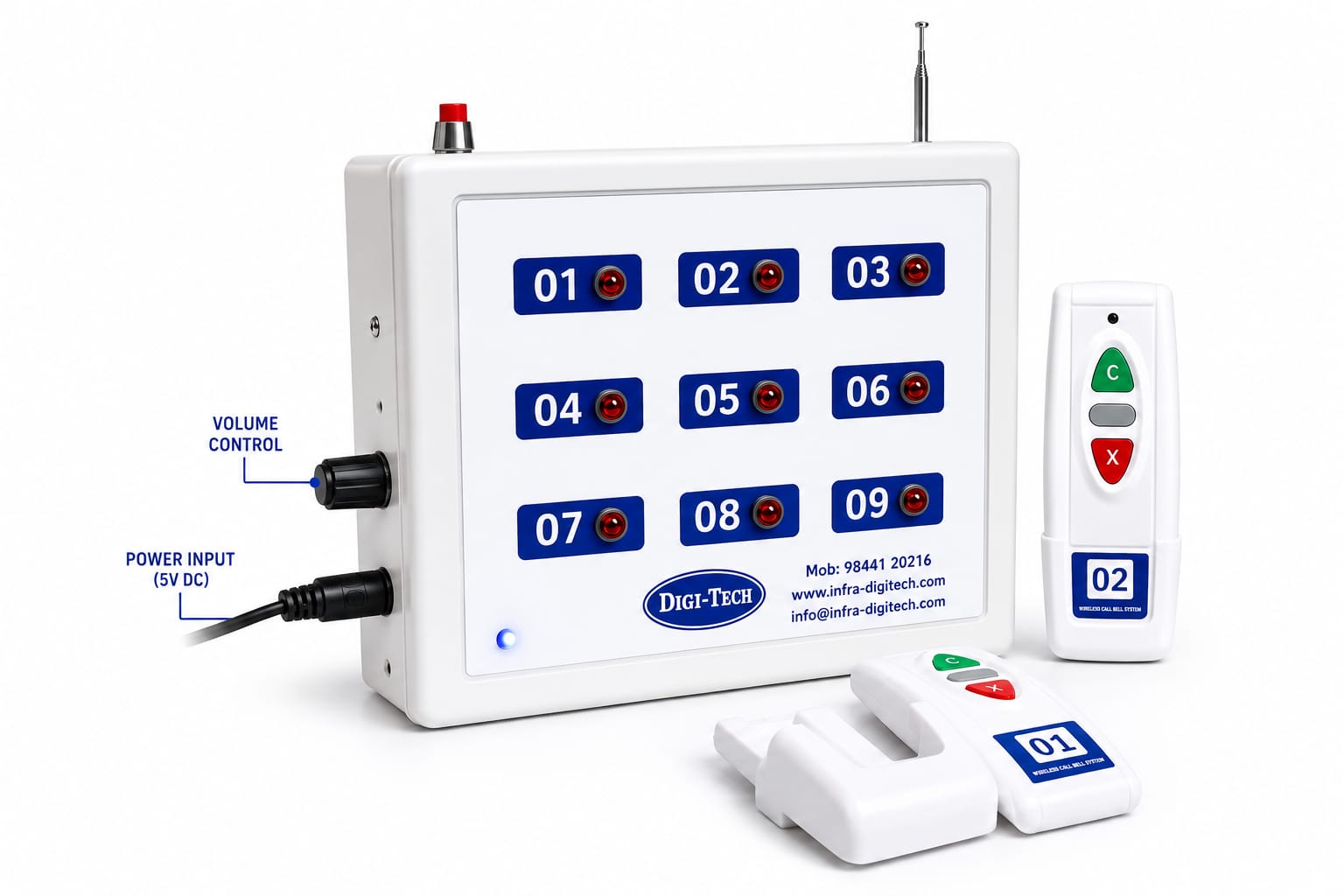
The same device goes by many names in India — wireless call bell system, calling bell system, peon calling system, attendant calling system, service bell, staff calling system. Whatever your industry calls it, the job is identical: someone presses a button, and the right person is alerted instantly with the caller's number on a display. This guide explains what a modern RF call bell system does, who it is for, what decides the price, and — the question we get asked most — when a simple call bell is enough versus when you actually need a full nurse calling system.
What a wireless call bell system actually is
A wireless call bell system has two parts. Calling units — small battery-operated remotes, each numbered, placed at a bed, cabin, table, counter or machine. And a receiver panel — a wall-mount or table-top LED display at the staff station that shows which unit called, with a buzzer alert. Good systems use secure long-range RF (radio frequency), so there is no wiring between units at all: power the receiver from a normal socket, hand out the remotes, and the system is live in minutes. That plug-and-play character is exactly why call bells have become the default choice for sites that cannot shut down for cabling work.
Both variants are covered in full on their own pages — the wireless call bell system with its 9-zone LED panel or number display, and the wired call bell system for sites that would rather not have batteries or radio in the mix at all.
- A 9-zone receiver supports up to 9 calling units — one panel covers a small ward, office floor or restaurant
- 3-button remotes: a normal call button, an emergency call button and a reset button
- Non-volatile memory: if power fails mid-call, the panel restores the active call when power returns
- Adjustable buzzer volume — from quiet clinic wards to noisy shop floors
- IP65 illuminated button options on our nurse-call range make buttons visible at night
Who uses call bell systems — and what they call them
In offices and government departments the same product is usually called a peon calling system or attendant calling system — a director or officer presses the desk remote and the display in the staff room shows which cabin is calling, ending the intercom-tag and shouting down corridors. In small hospitals, clinics, nursing homes and day-care centres it works as a simple nurse calling system: each bed gets a remote, the panel sits at the nurse station. In old-age homes, senior living and assisted-living facilities, residents carry the remote and can call a caretaker from anywhere in the building. Hotels and restaurants use it for table and room service calling. And on factory floors it has a use most buyers don't expect: operators press the call bell when a machine develops a fault, instantly summoning the maintenance or tech-support team to that station — no PA announcements, no walking across the plant, and the LED panel shows exactly which machine line needs attention.
Call bell vs full nurse calling system — which do you need?
This is the decision that saves (or wastes) the most money. A call bell system tells staff that somebody called and from where — for many sites, that is the entire requirement. A full nurse calling system adds ward-grade infrastructure on top: toilet pull-cord switches, door indicators, Code Blue emergency mode, nurse-station consoles, dashboards, response-time reporting and NABH-aligned compliance features. Our honest rule of thumb: if you run a clinic, a small hospital under roughly 10-15 beds, a nursing home without accreditation plans, an office, factory or restaurant — start with the call bell system. If you are chasing NABH or JCI accreditation, need toilet pull-cords and Code Blue, want response-time reports, or operate a multi-ward hospital, you need the Standard or Advanced Nurse Calling System. In fact, the wireless variant of our Basic Nurse Calling tier IS the call bell system — same engineering, sold standalone.
If that ward-grade layer is what you actually need, the step up is the nurse calling range: a wireless nurse call system where the ward cannot be closed for cabling, or a wired nurse call system where it can.
The upgrade path is real, not a sales line
Because the call bell shares our nurse-call platform engineering, a facility that grows can add a proper nurse-station setup later without throwing away the concept — many of our hospital customers started with a call bell in one ward and upgraded to the Signavanc nurse calling range as they expanded.
What decides the price of a call bell system in India
- 1Number of calling units — the receiver supports up to 9 zones; you pay per remote, so a 4-bed clinic costs less than a 9-cabin office
- 2Receiver count — large or multi-floor sites may need more than one receiver panel
- 3Remote type — standard 3-button handheld vs wall-mount holders at every point
- 4Range requirements — standard RF covers a typical building; long-range or multi-floor coverage needs site assessment
- 5Emergency function — whether you need the dedicated emergency button wired into your response workflow
- 6Buying direct from the manufacturer vs a reseller — as the Bengaluru manufacturer, we quote factory pricing with no dealer margin, same-day
We deliberately do not publish a single price because a 3-remote dental clinic and a 9-machine factory line are different systems — but call bell systems are the most affordable entry point in the entire calling-system category, typically a fraction of a full nurse call installation. Request a quote with your unit count and you will have a factory price the same day.
Buyer's checklist — six questions before you order
- Does the panel restore active calls after a power cut? (Non-volatile memory is the difference between a missed patient call and a restored one)
- Can the buzzer volume be adjusted for your environment?
- Are the remotes battery-operated with wall-mount holders included?
- Is there a dedicated emergency button distinct from the normal call?
- Is the manufacturer ISO 9001:2015 and CE certified, with local service? (Ask for certificate numbers — ours are published and verifiable)
- Is there an upgrade path to a full nurse calling system if your facility grows?
See the full specifications, FAQs and applications of our plug-and-play Wireless Call Bell System — engineered and manufactured in Bengaluru.
View the Wireless Call Bell SystemFrequently asked questions
What is a peon calling system and how is it different from a call bell system?
They are the same product under different names. In offices and government departments the system is called a peon calling system or attendant calling system — an officer presses a desk remote and a display in the staff area shows which cabin called. In hospitals the same hardware is used as a simple nurse calling solution, and in restaurants as a waiter calling system.
Can a call bell system replace a nurse calling system in a small hospital?
For clinics, nursing homes and small hospitals that simply need bed-to-staff calling, yes — the call bell system is a budget-friendly, plug-and-play alternative, and it is the wireless variant of our Basic Nurse Calling tier. Facilities pursuing NABH accreditation, or needing toilet pull-cords, Code Blue and response-time reporting, should choose the Standard or Advanced Nurse Calling System instead.
Can call bell systems be used in old-age homes and senior living facilities?
Yes — senior care is one of the most common uses. Residents keep or carry the numbered remote and can call a caretaker from anywhere in the building, and the caretaker's LED panel shows exactly who called. Larger facilities that need pendant units with battery-level monitoring should look at our dedicated Old-Age / Senior Living Calling System.
How are call bell systems used in factories?
Machine operators press the call bell when a machine develops a fault or needs material, instantly alerting the maintenance or tech-support team with the exact station number on the LED panel. It eliminates PA announcements and walking time, and the emergency button doubles as a safety alert.
How much does a wireless call bell system cost in India?
Pricing depends mainly on the number of calling units, the number of receiver panels and range requirements. It is the most affordable product in the calling-system category — typically a fraction of a full nurse call installation. As the manufacturer, Infra DigiTech provides a same-day factory quotation.