
GPS synchronised digital clocks
Every quartz clock in your building is drifting, each at its own rate, which is why no two of them read alike by the end of a quarter. A GPS clock takes its time from the satellite constellation instead, so it never needs setting and never disagrees with the next one down the corridor. We build them two ways — as independent clocks, and as a wireless master–slave system for rooms that cannot see the sky.
Start with where the clocks are going
The choice is not really about accuracy — both lines lock to the same satellites. It is about whether each clock can receive a signal where it hangs, or whether one unit has to receive on behalf of all the others.
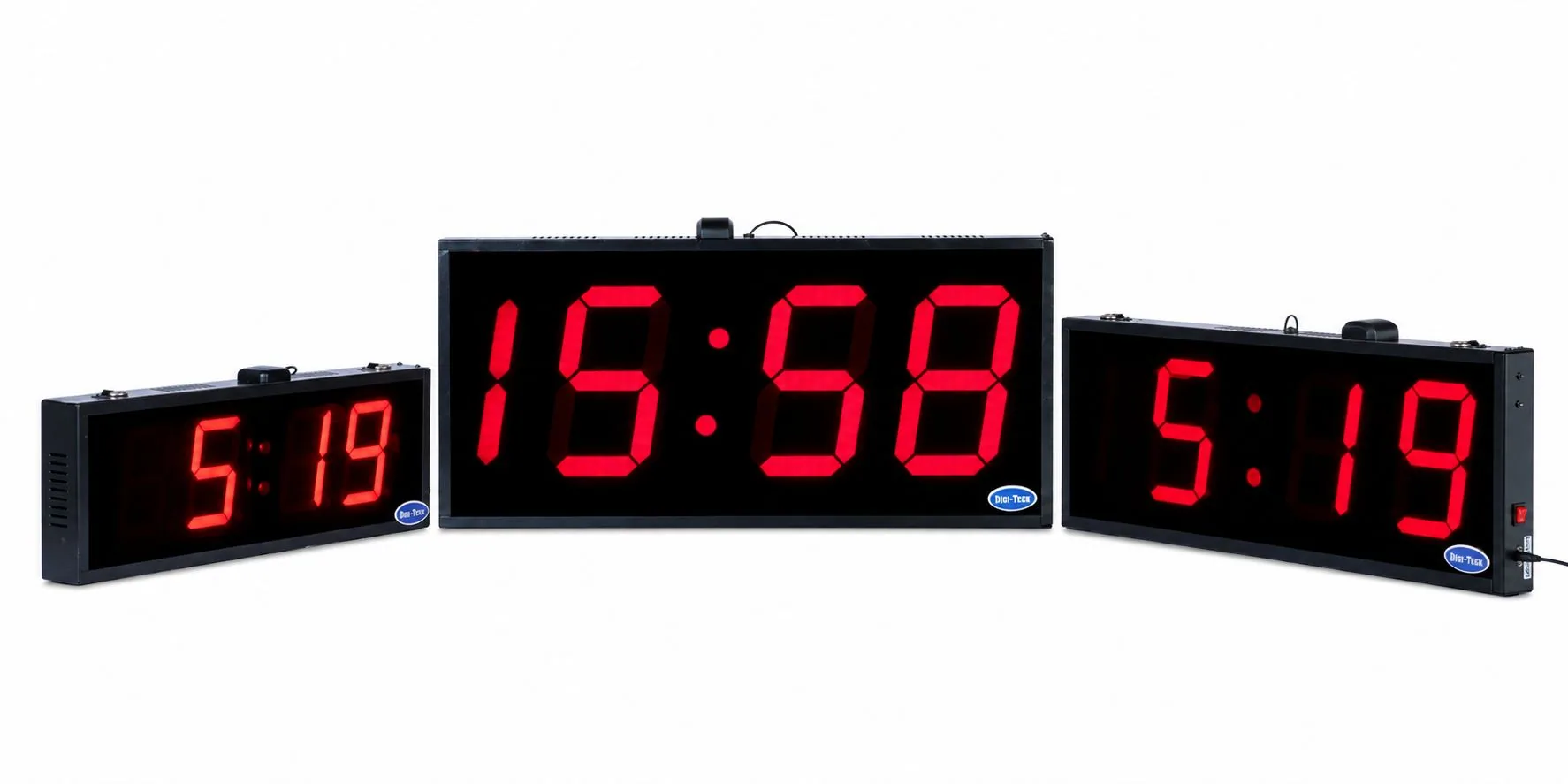
Industrial & corporate GPS clocks
Plants · offices · server rooms · labour rooms
Each clock carries its own GPS receiver and shows satellite time on its own. Order one for a labour room or a hundred across a plant — they will still all read the same, because they are all reading the same satellites.
- 2.3″ to 12″ digits, single, double or three-sided
- MS powder-coat or stainless steel, IP20 to IP66
- Indoor, outdoor P10 and date / day / temperature variants
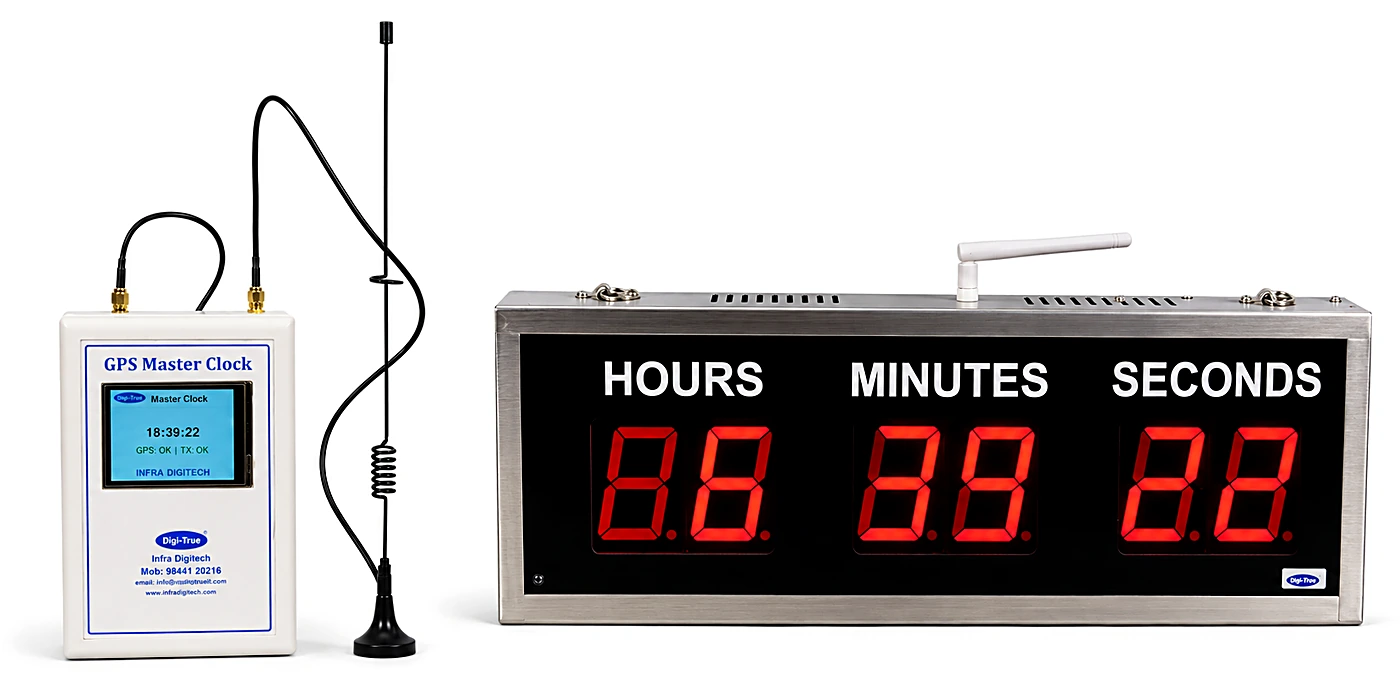
Master–slave clock system
Pharma · cleanrooms · 865 MHz wireless
One GPS master clock takes the time and broadcasts it over licence-exempt radio to slave displays up to 650 m away. Nothing on the wall needs a satellite view, and nothing between the master and the slaves needs cable.
- Built for rooms a GPS antenna cannot see the sky from
- Written for GMP and data-integrity audits
- Slaves hold time on their own RTC if the master falls silent
Three ways the right time reaches a clock
Most sites use one. Some use two — satellite as the source, the network as the cross-check. All three are available on the same hardware, so the decision does not lock you into a different product.
GPS satellite
The default, and the most accurate.
A receiver locks onto the GPS constellation and recovers Coordinated Universal Time directly from it, then offsets it to Indian Standard Time. Nothing on your network is involved, so nothing on your network can knock it out of step. Accuracy against UTC is in the millisecond range while the lock holds.
Needs a receiver with a view of the sky — a window sill, a roof puck or an external antenna.
Network / NTP
For clocks already sitting on a LAN.
The clock asks a time server on your network for the time using the Network Time Protocol, exactly the way your servers and workstations do. If your IT team already runs a disciplined NTP source, the clocks inherit it and the whole estate — logs, badges, cameras, clocks — reads alike.
Needs a LAN drop or PoE at each clock, and an NTP source your IT team maintains.
Stand-alone RTC
The fallback, and sometimes the whole answer.
A temperature-compensated real-time clock with its own backup battery keeps counting when no other source is available. Every GPS and network clock we build carries one, so a lost signal or a power cut is a pause in synchronisation rather than a clock that has to be reset by hand.
Set once at commissioning; drifts slowly and is corrected the moment a signal returns.
Independent clocks, or one master and its slaves
This is the decision that shapes the quotation, and it is usually settled by walking the site rather than by reading a datasheet.
Every clock reads the sky for itself
There is no network here at all. Each clock has a receiver and an antenna, and each one recovers the time from the satellites independently. Two units never exchange a single message, yet they agree permanently — because they are both following the same constellation rather than following each other. Nothing to pair, nothing to survey, and a failure in one clock has no effect on any other.
One clock reads it, the rest listen to that one
The master carries the only GPS receiver on site and re-broadcasts what it recovers over short-range radio. The slave displays carry a receiver for that broadcast and nothing else. The satellite problem is solved once, at a single position you can choose freely, instead of being solved again in every room — which is what makes a display in a sealed cleanroom possible.
| Independent GPS clocks | Master–slave system | |
|---|---|---|
| Time reaches each clock | From its own GPS receiver | From one master, by radio |
| Needs sky visibility | At every clock | At the master only |
| Cabling between clocks | None — each is independent | None — 865 MHz wireless |
| Adding a clock later | Order and hang it | Pair it to the existing master |
| If one unit fails | Only that clock stops | A slave stops; the rest carry on |
| Best for | Rooms and floors with signal, mixed sizes and finishes | Sealed rooms, cleanrooms, basements, blocks with no line of sight to sky |
| Typical buyer | Plant, facilities, HR, hospital admin | Pharma QA, validation, cleanroom projects |
How big should the digits be?
The commonest mistake on a clock enquiry is ordering by budget rather than by sightline, and it only becomes obvious after the clock is on the wall. Measure the distance from the furthest person who needs to read it and work back from there.
The rule we use
Roughly one inch of digit height for every 4.5 m of viewing distance. Go one size larger if the room is brightly lit, if people read the clock at an angle, or if there is glazing in the sightline.
| Digit height | Comfortable reading distance | Typically specified for |
|---|---|---|
| 2.3″ | Up to 10 m | Desk edge, reception counter, small cabin, date-and-time strips |
| 4″ | Up to 18 m | Labour rooms, OTs, meeting rooms, cleanroom corridors, control rooms |
| 6″ | Up to 27 m | Wards, shop-floor bays, canteens, lobbies, classrooms |
| 8″ | Up to 36 m | Assembly lines, warehouses, large open offices |
| 10″ | Up to 45 m | Production halls, atriums, concourses |
| 12″ | Up to 55 m | Yards, platforms, stadium-scale interiors, outdoor P10 |
Who buys a synchronised clock, and why
Almost nobody buys these because the old clock stopped. They buy them because two records that should have matched did not, and the clock turned out to be the reason.
Manufacturing & plants
Shift change, line changeover, downtime logs and OEE all reconcile only if the floor, the supervisor's cabin and the ERP agree on the minute.
Pharma & cleanrooms
Batch records, environmental monitoring and audit trails have to line up under GMP scrutiny. This is the master–slave line's home ground.
Hospitals & labour rooms
Time of birth is a legal entry on a birth certificate, and it is read off the wall to the second.
Data centres & server rooms
A wall clock that matches the NTP source removes an argument during an incident review.
Corporate & IT campuses
Several buildings, one time — including the reception wall everybody checks on the way in.
Outdoor & public areas
Gates, yards, platforms, gardens and parking, in weatherproof enclosures with sunlight-readable digits.
Our standard clock range
These are the codes on our price list and our purchase orders. Anything outside this list is a build to your drawing, which we do routinely — the codes exist to make repeat orders quick, not to limit what we can make.
| Model | Description |
|---|---|
| DT/4CLK-01 | 4" GPS Clock |
| DT/6CLK-02 | 6" GPS Clock |
| DT/8CLK-03 | 8" GPS Clock |
| DT/10CLK-04 | 10" GPS Clock |
| DT/12CLK-05 | 12" GPS Clock |
| DT/DTCLK-08 | Date & Time Clock — 2.2" |
| DT/P10CLK-09 | P10 Clock (Outdoor) |
| DT/4CLK-11IP | IP-Based Clock — 4" |
| DT/2CLK-12IP | IP-Based Clock — 2.2" |
Clocks that do something more than tell the time
International world clock
Several cities on one panel or across a lobby wall, for trading floors, hotel receptions and offices working to more than one market.
See the rangeOperation theatre timer
Elapsed-time and countdown display for surgical use, where what matters is not the time of day but how long the procedure has been running.
See the timerHeritage clock for the home
The same satellite-synchronised movement in a hand-carved wooden case, for houses, banquet halls and restaurants. It never needs setting.
See the clockProduction display boards
Target against actual on the shop floor. Frequently ordered on the same project as the clocks, and mounted on the same run of wall.
See the boardsGPS clocks — common questions
What buyers ask us before they specify. If yours is not here, our engineering team will answer it on the phone rather than in a brochure.
What is a GPS synchronised digital clock?
It is a digital display whose time comes from the GPS satellite constellation rather than from a quartz movement someone set by hand. The receiver recovers Coordinated Universal Time from the satellite signal, applies the Indian Standard Time offset, and drives the display. Because the source is the same for every unit, two clocks fed this way agree with each other permanently — there is no monthly drift to correct and no seasonal adjustment to make.
What is the difference between a standalone GPS clock and a master–slave clock system?
A standalone clock has its own GPS receiver and needs its own view of the sky. A master–slave system puts one receiver in a place where reception is good, and that master then broadcasts the time to slave displays that carry no receiver at all. If your clocks are going into rooms with a window or an accessible ceiling, standalone is simpler. If they are going into sealed cleanrooms, basements or interior corridors, master–slave is the only practical answer. The comparison table above lays out the rest.
How accurate are these clocks?
Two figures matter and they describe two different states. While a GPS lock is held, time is recovered to within milliseconds of UTC. If the signal is lost, the clock free-runs on its internal temperature-compensated RTC, and the specification you should judge that state by is drift per year rather than drift against UTC. We publish both rather than quoting the flattering one — ask us for the figures against the exact model you are specifying.
Do we need an internet connection?
No. GPS time arrives from satellites, not from the internet, so a GPS clock works in a plant with no network at all. The Network / NTP option is there for the opposite case — a site that would rather have its clocks agree with its own servers than with a separate satellite receiver.
What happens during a power cut?
The display goes dark, but the timekeeping does not stop. A backup battery keeps the internal RTC running, so the clock comes back up showing the right time instead of blinking at zero. Where a display must stay lit through an outage, we build the clock to run from the site UPS.
Do the clocks need to be reset for daylight saving?
India does not observe daylight saving, so in an Indian installation there is nothing to reset. For customers running the same fleet across sites that do, the offset is a configuration setting rather than a manual change at each clock, and our International World Clock range is designed for multi-zone display in the first place.
What digit height should we order?
Work backwards from the furthest person who has to read it. As a working rule we allow roughly one inch of digit height for every 4.5 m of viewing distance, which is where the sizing table above comes from. Bright ambient light, an oblique viewing angle or a glazed door in the sightline all argue for going one size up — it costs very little at the quotation stage and cannot be fixed afterwards.
Can we get stainless steel, waterproof or flush-mounted clocks?
Yes. Enclosures are built to the installation rather than picked off a shelf — mild steel powder-coated for a plant wall, stainless steel where it will be wiped down, and sealed flush-mount fronts for cleanroom panels. Ingress protection runs from IP20 for a dry indoor cabin to IP66 for a clock that will be hosed. Tell us the room and we will tell you what it should be built from.
Are these made in India?
Yes. Infra DigiTech designs and manufactures them at our Bengaluru facility, which is also why enclosure size, digit height, mounting and finish are all things we can change for one order rather than things you have to accept as they come. We are ISO 9001:2015 certified and CE marked.
Send us the room list
How many clocks, which rooms, the furthest reading distance in each, and whether any of them sit somewhere a satellite signal will not reach. That is enough for us to come back with the architecture, the digit sizes and a same-day quotation.