
Industrial & corporate GPS digital clocks
Each unit carries its own receiver and reads the time straight from the satellites, so it is a single product order rather than a system installation. Hang one in a labour room or a hundred across a plant — they will agree with each other on the second, permanently, without anything connecting them.
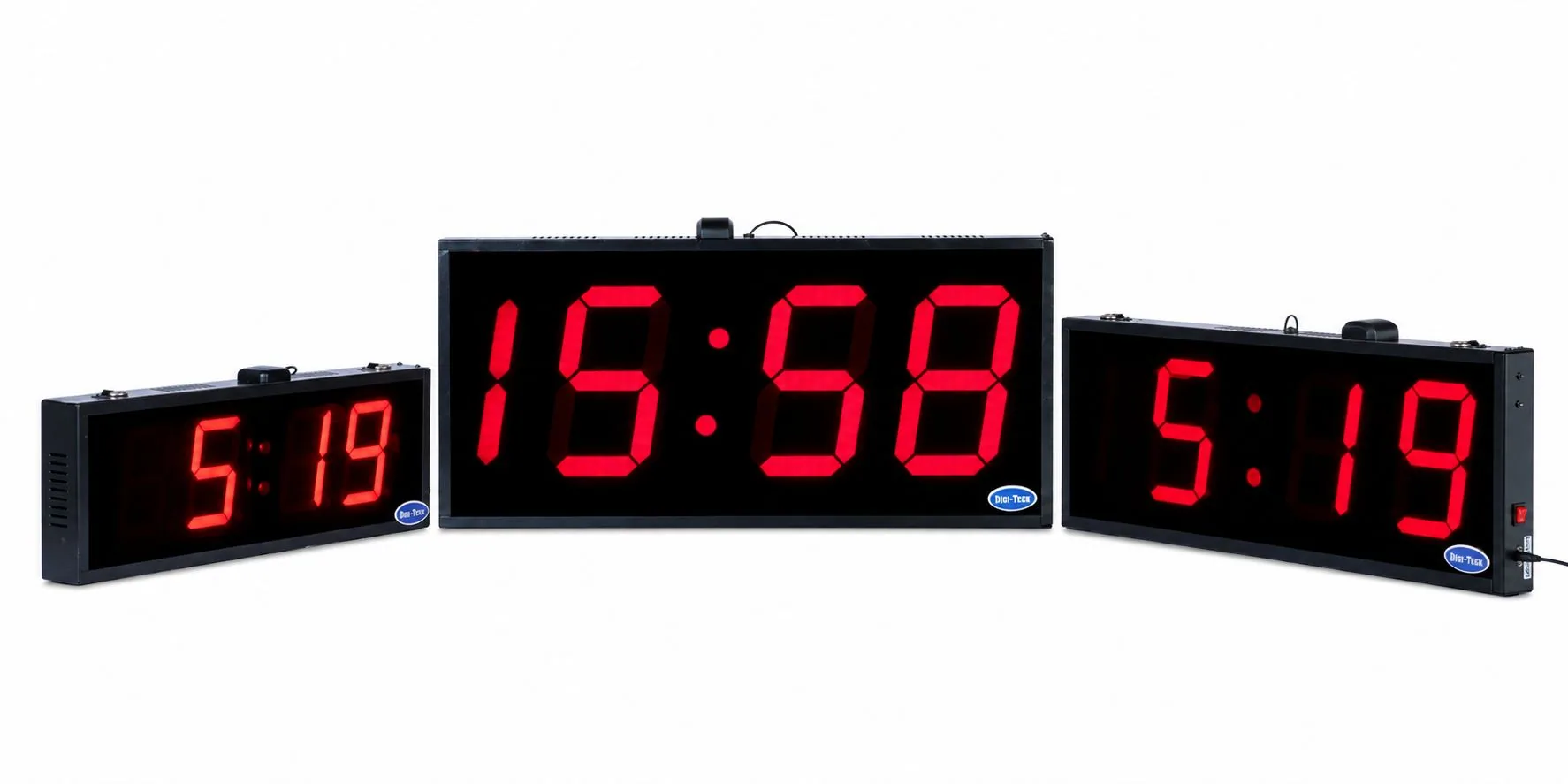
Nothing to connect, nothing to set
A small GPS puck sits on top of the clock, or on a short lead to a window or a roof. Within a few minutes of power-up it has acquired the satellites, recovered the time, applied the Indian Standard Time offset and put it on the display. From then on there is no commissioning step, no server to point it at and no annual visit to correct the drift.
That independence is the point. Two clocks fitted three years apart on opposite sides of a campus still show the same second, because neither of them is copying the other — they are both copying the same constellation.
If some of your rooms cannot see the sky at all, that is a different architecture rather than a different antenna. The comparison on the hub page sets out when to stop specifying independent clocks and move to a master and its slaves.
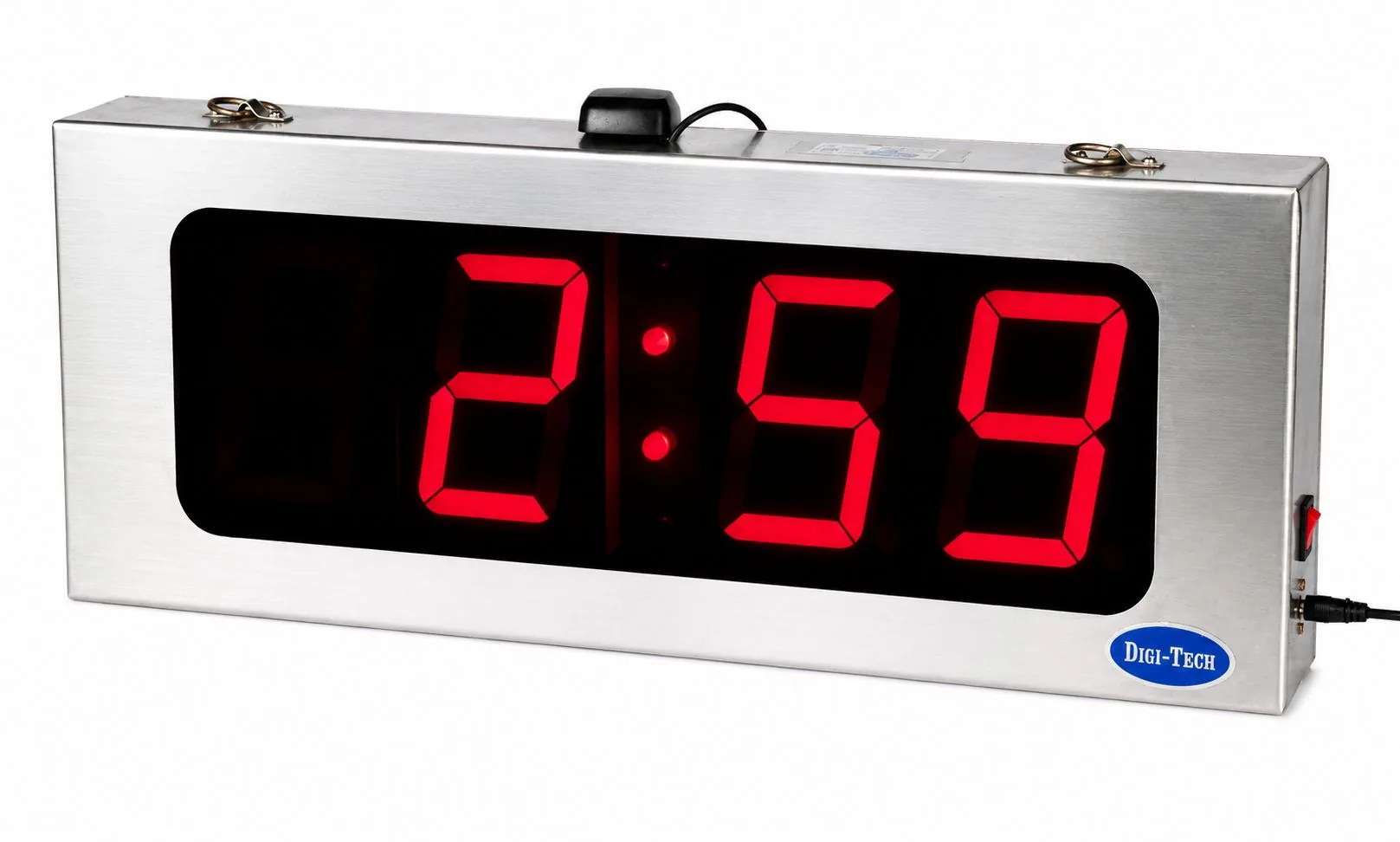
Stainless steel enclosure with the GPS antenna sitting on the cabinet — the whole installation, in one box.
Six decisions, and then it is your clock
We make these rather than buy them in, so every line below is a choice on the order form instead of a model you have to find in a catalogue. Digit height is worked out from viewing distance — the table for that is on the hub page.
Digit height and format
2.3″ through 12″, in HH:MM or HH:MM:SS, on a 12-hour or 24-hour cycle. Seconds are worth having wherever somebody transcribes the time into a record; leave them off where the clock is only there to keep a shift moving.
One face, two or three
A single-sided clock is read from in front of it. A double-sided unit hangs from a ceiling in a corridor and is read from both directions, and a three-sided one sits on a corner or a column where people approach from anywhere. Nothing changes electrically — it is the same clock with more faces.
Enclosure and finish
Mild steel with a powder-coat for an ordinary wall, and stainless steel where the clock will be wiped down, sits in a humid room, or has to look like part of the equipment rather than part of the furniture. Custom colours and etched or vinyl legends are a normal request, not a special one.
Ingress protection
IP20 for a dry cabin, IP54 for a dusty shop floor, IP65 for a washdown area or a covered outdoor position, and IP66 where the clock will genuinely be hosed. Getting this wrong is the single commonest cause of a clock coming back within a year.
Seven-segment or P10 dot-matrix
Seven-segment LEDs give the crispest, brightest numerals and are what most indoor clocks use. P10 dot-matrix modules are the outdoor answer — high-brightness pixels that stay readable in direct sun, and able to show text alongside the time when the site wants a message line.
More than the time
Date, day and month on a second row, ambient temperature, or an auto-brightness sensor that dims the display at night so a clock in a ward or a hotel corridor is not glaring at three in the morning. All specified per unit, not per order.
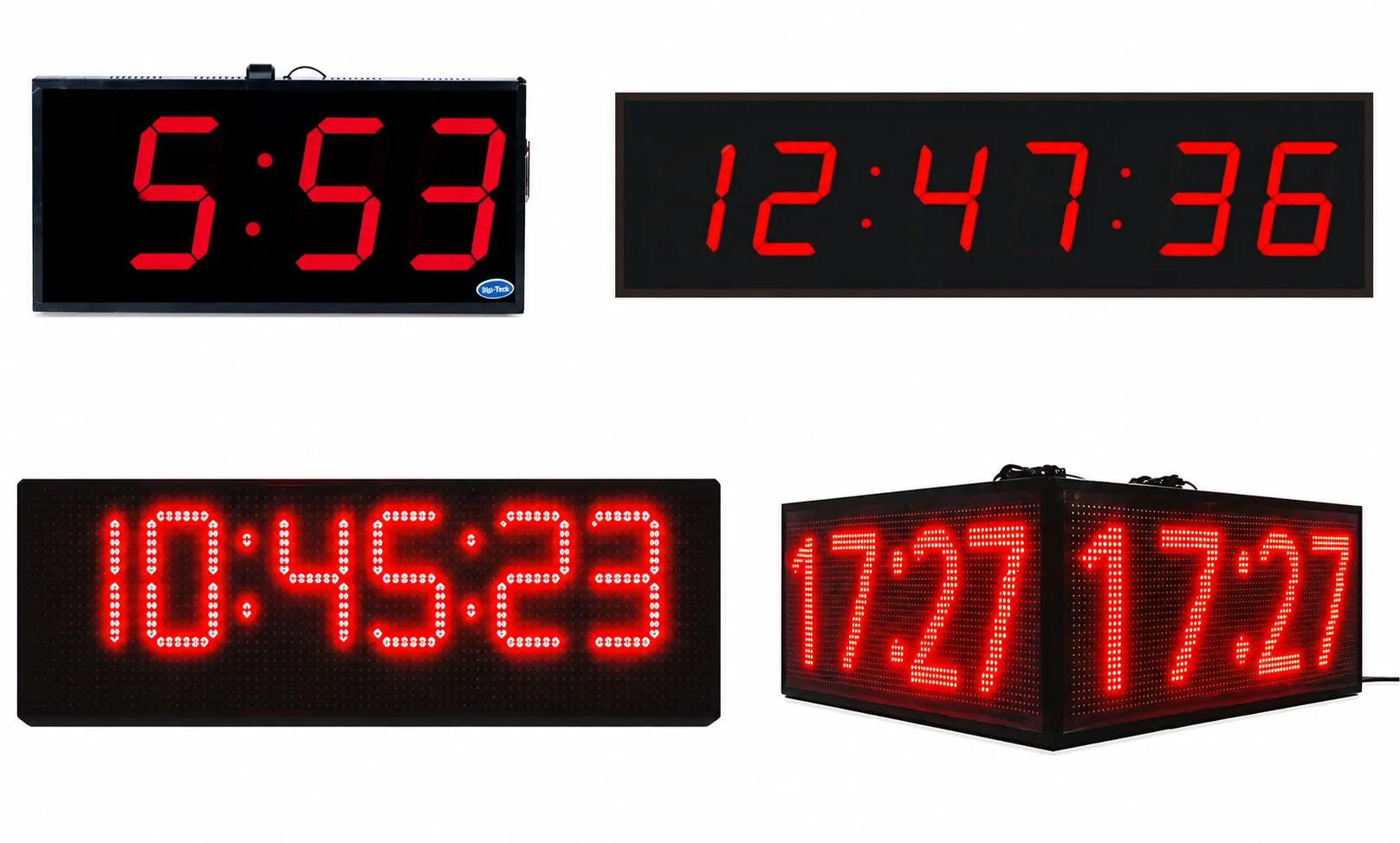
Four faces of the same platform — four-digit, six-digit, P10 outdoor and a two-faced ceiling unit.
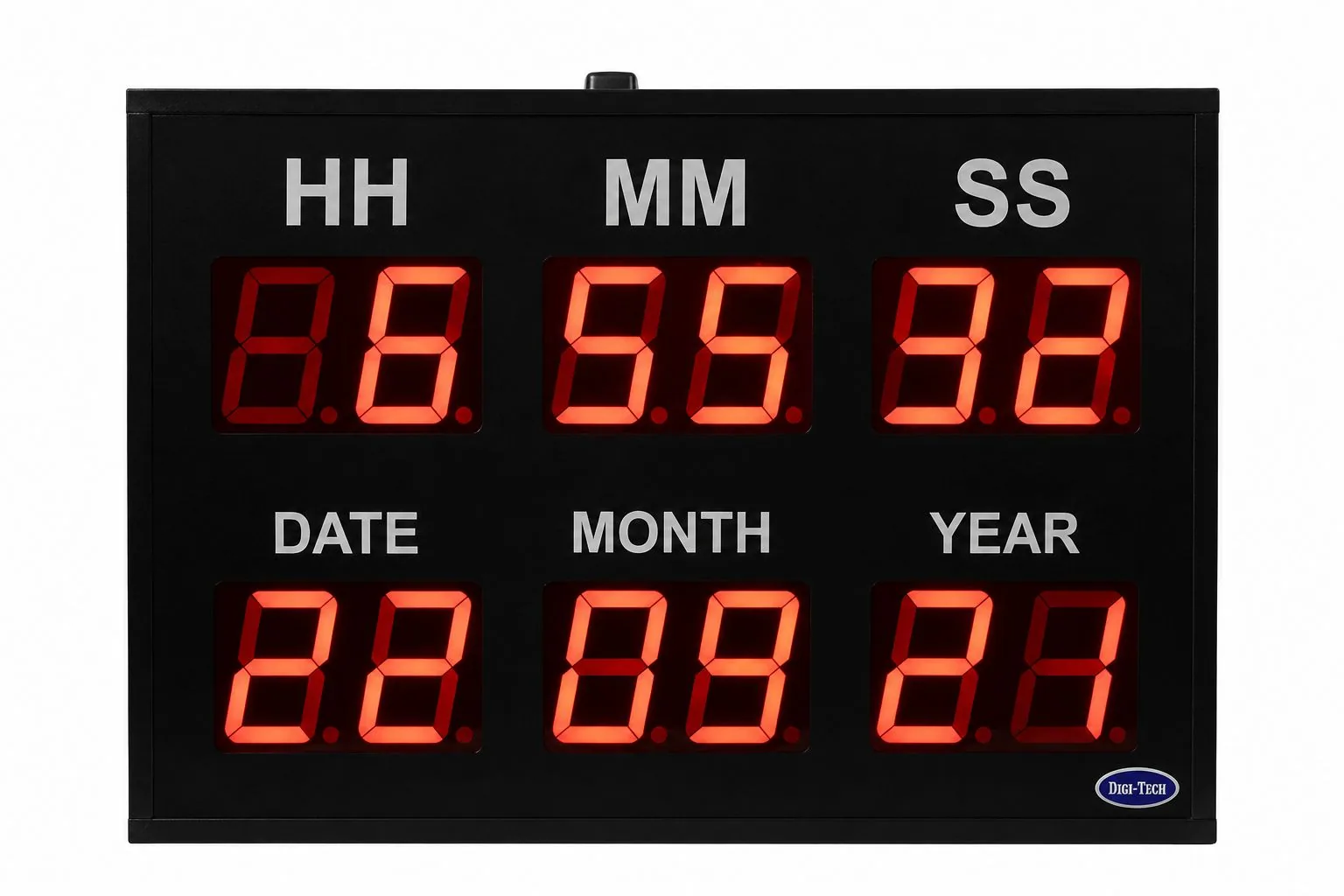
The date-and-time build — seconds on the top row, calendar underneath, for records offices and dispatch bays.
Four rooms, four different arguments
The clock is the same. What changes is why somebody is prepared to pay for an accurate one, and that is worth being clear about before you write the specification.
Labour rooms, operation theatres and critical care
Where the time on the wall becomes the time on a document.
Time of birth is a legal entry on a birth certificate, and it is read off the wall clock, to the second, by a person with both hands busy. A quartz clock that has drifted four minutes since it was last set turns that entry into something nobody can defend. A satellite-locked HH:MM:SS display removes the question entirely — and the same argument applies to anaesthesia start times, tourniquet times and the timestamps that go into an ICU chart. We build these in hygienic powder-coat or stainless steel so infection control has no objection, in 4″ and 6″ for a delivery suite and 8″ where the clock has to be read from the far side of a theatre.
Plants, shop floors and warehouses
Shift discipline is only as good as the clock everybody trusts.
Every downtime log, changeover record and shift handover is written against a time somebody read off a display. When the line clock, the supervisor's cabin and the ERP disagree by a few minutes, the reconciliation happens in a meeting rather than in the data. Large digits in IP54 or IP65 enclosures, hung where the line can see them, put an end to that argument for the price of a few hours of that meeting. Garment units, machine shops, assembly halls and cold-chain warehouses are our commonest installations, and the clock usually goes up on the same wall as a production display board.
Corporate campuses, control rooms and server rooms
One time across several buildings, including the wall people actually look at.
Your servers are already disciplined to a time source; the walls are not. In a control room, a NOC or a data centre, an incident review is an exercise in lining up what happened against when — and a wall clock that does not match the log is worse than no clock at all. These installations are the commonest place we are asked for the Network / NTP option instead of GPS, precisely so the display and the log inherit the same source. Reception walls, boardrooms, training rooms and cafeterias usually come along on the same order.
Outdoor — gates, yards, platforms and public spaces
Readable in direct sun, sealed against monsoon.
An outdoor clock has two jobs an indoor one does not: survive weather, and stay legible with the sun on it. That means a sealed IP65 or IP66 enclosure with the cable entry treated properly, high-brightness P10 modules rather than ordinary LEDs, and an ambient sensor so the display is not blinding after dark. Security gates, factory yards, transport bays, parks, parking decks and sports grounds are where these end up, generally in 10″ or 12″ because the reading distance outdoors is always longer than the drawing suggests.
The platform, in one table
Every row is a choice rather than a fixed value, because the clock is built after the order rather than before it. Tell us the room and we will fill the table in for you and send it back as the quotation.
- Room by room list with quantities
- Furthest reading distance in each room
- Indoor, washdown or fully outdoor
- Whether a power point exists at the position
- Any drawing or standard the finish must match
| Time source | GPS satellite · Network / NTP · stand-alone RTC |
| Digit height | 2.3" · 4" · 6" · 8" · 10" · 12" |
| Display | Seven-segment LED · P10 dot-matrix (outdoor) |
| Format | HH:MM · HH:MM:SS · 12 or 24 hour · date / day / month row optional |
| Faces | Single-sided · double-sided · three-sided |
| Enclosure | Mild steel powder-coated · stainless steel · custom finish |
| Ingress protection | IP20 · IP54 · IP65 · IP66 |
| Mounting | Wall · ceiling suspended · hanging · flush · panel |
| Backup | RTC battery, and power-failure battery backup where specified |
| Extras | Ambient temperature · auto-brightness sensor · custom legends |
| Supply | 230 V AC, 50 Hz — UPS or DC supply on request |
| Warranty | 1 year against manufacturing defects |
Plants and campuses we have fitted
Display and timing work delivered for manufacturers and corporate campuses across Karnataka and beyond. Ask us for a reference in your sector and we will put you in touch rather than send you a logo.
When an independent clock is the wrong tool
Sealed cleanrooms, basements, interior corridors and blocks with a steel deck overhead defeat a satellite receiver no matter how the antenna is placed. Running a separate antenna cable to every one of those rooms is expensive and fragile. One master clock in a position with a clear view, broadcasting to slave displays by radio, solves all of them at once — and it is also the build we take into pharmaceutical facilities, where the enclosure and the audit trail matter as much as the time.
The same movement, in a case people are meant to look at
A powder-coated industrial clock is right for a plant floor and wrong for a hotel lobby. The Heritage clock runs the same GPS-synchronised movement inside a hand-carved wooden frame, for receptions, restaurants, banquet halls and clubhouses — and for the boardroom wall where an engineering enclosure looks out of place. Standard at 24 x 14 inches, or made to any size and digit height you specify.
Specifying an industrial clock
Sizing, mounting, weather and the questions that come up once a drawing is on the table.
How does a GPS clock work if it is hanging inside a building?
The receiver is more sensitive than people expect, and a small puck antenna sitting on top of the clock or run on a short lead to a window sill is enough in most indoor positions. Where the room is deep inside a building, has a metal deck above it, or is a shielded space, we run an external antenna to a position with a sky view — and where even that is impractical for a group of rooms, a master–slave system is the honest answer rather than a bigger antenna.
Can these clocks synchronise from our network instead of GPS?
Yes. The same clock can be ordered to take its time from an NTP server on your LAN, which is what most data centres and IT campuses prefer because their logs, badge readers and cameras already run from that source. It needs a network drop at each clock, so it is a decision to take before the cabling contractor leaves site rather than after.
What size do we need for a labour room?
A 4″ display is comfortable for a delivery suite where the person recording the time is within about eighteen metres of the clock, which covers almost every labour room we have fitted. Go to 6″ for a large theatre or where the clock has to be read from a corner of the room, and to 8″ if it is mounted high on a wall above equipment. Always specify HH:MM:SS here — seconds are the whole reason the clock is in that room.
Are stainless steel clocks available for hygiene areas?
Yes, and they are our standard recommendation for anywhere that gets wiped with a disinfectant — theatres, labour rooms, food and beverage lines, and pharmaceutical support areas. Stainless does not shed the way a chipped powder-coat does, and it survives repeated chemical cleaning. For classified cleanrooms specifically, the enclosure requirement goes further than the finish, and that is covered on our master–slave page.
Can one clock show the time on both sides of a corridor?
That is exactly what the double-sided variant is for. It hangs from the ceiling on a bracket or a drop rod and shows the same time on both faces, so nobody has to turn around to read it. Three-sided units do the same on a column or a corner where people approach from more than two directions.
Will an outdoor clock survive monsoon and direct sun?
The ones we build for outdoor use will, because they are specified for it rather than adapted to it — an IP65 or IP66 sealed enclosure, treated cable entry, and P10 high-brightness modules that stay readable in full sun. What does not survive is an indoor clock moved outside because the position changed after ordering, so tell us at enquiry stage if a unit is going anywhere the weather can reach.
How are they mounted and who installs them?
Wall brackets, ceiling suspension, hanging drop rods, flush mounting into a panel and rack or panel mounting are all standard. The clock needs a power point at the position and, for GPS units, somewhere sensible for the antenna. Our team commissions the system and hands over a working installation; where a site prefers to use its own electrical contractor for the fixing and the power point, we will give them the mounting details and antenna guidance in advance.
Can you build a clock to our drawing?
Yes — this is a manufacturing business, not a reselling one. Enclosure dimensions, digit colour, legend text, mounting arrangement, supply voltage and the extra display rows are all things we change for a single order. If you have an architectural constraint or a standard your other displays follow, send it with the enquiry and the quotation will come back matching it.
Send us the room list
Quantities, reading distances and whether anything is going outdoors. We will come back with digit sizes, enclosure recommendations and a same-day quotation.