
Master–slave synchronised clock system
One clock receives the satellites. Every other clock in the building receives that one. It means a display can hang in a sealed cleanroom, a basement or an interior corridor and still show satellite time to the second — with no antenna in the room, no cable between the units, and nothing for a validation team to object to.
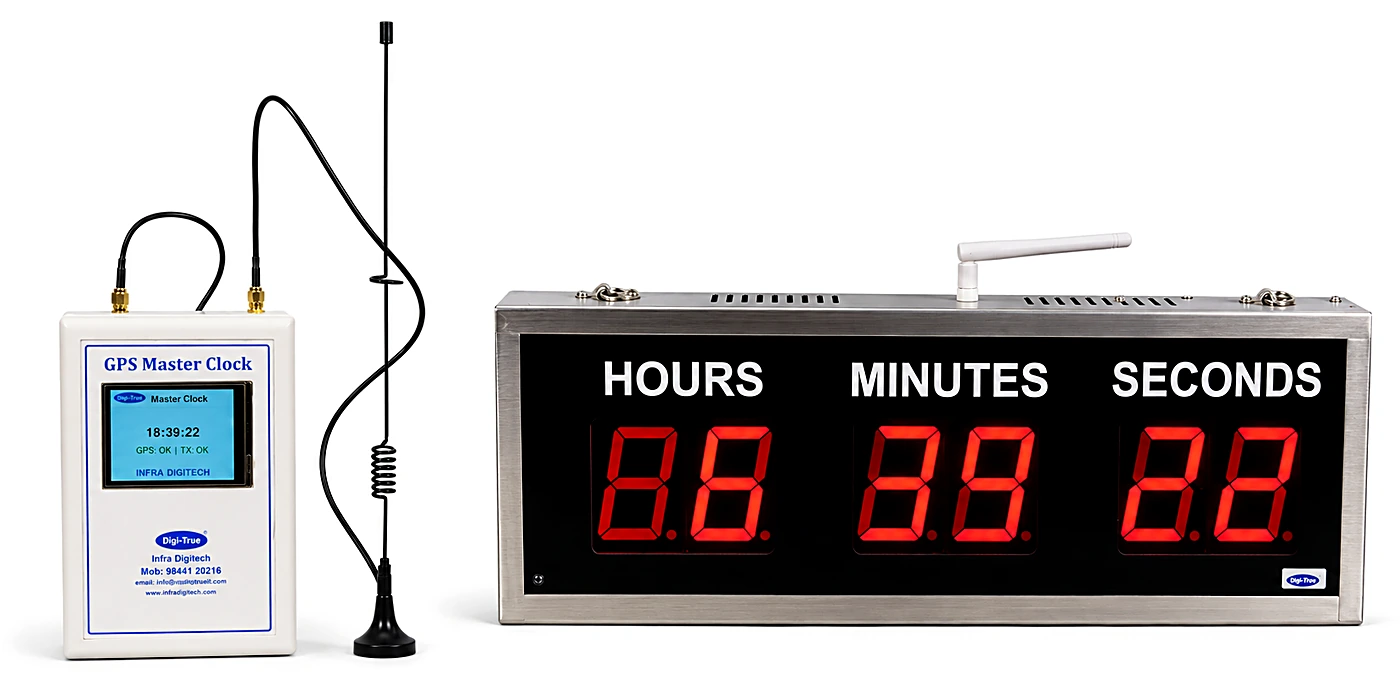
One receiver, many displays
The whole design exists to move a hard problem — getting a satellite signal into a sealed room — to somewhere it is easy to solve.
The master listens
A GPS puck antenna on a window, a ledge or a roof feeds the master clock, which acquires the constellation and recovers Coordinated Universal Time from it. Its receiver will track as many as 42 satellites, so a partly obstructed sky still leaves it plenty to work with.
The master broadcasts
A second antenna — the whip on the magnetic base — transmits the recovered time on the 865 MHz band, which India has de-licensed for short-range devices. No spectrum licence, no annual fee, and nothing on the plant network to configure.
Every slave displays it
Slave clocks carry a receiver and an antenna but no GPS at all. They simply show what the master sends, which is why they can hang in a sealed cleanroom, a basement corridor or an interior lab where a satellite signal was never going to arrive.
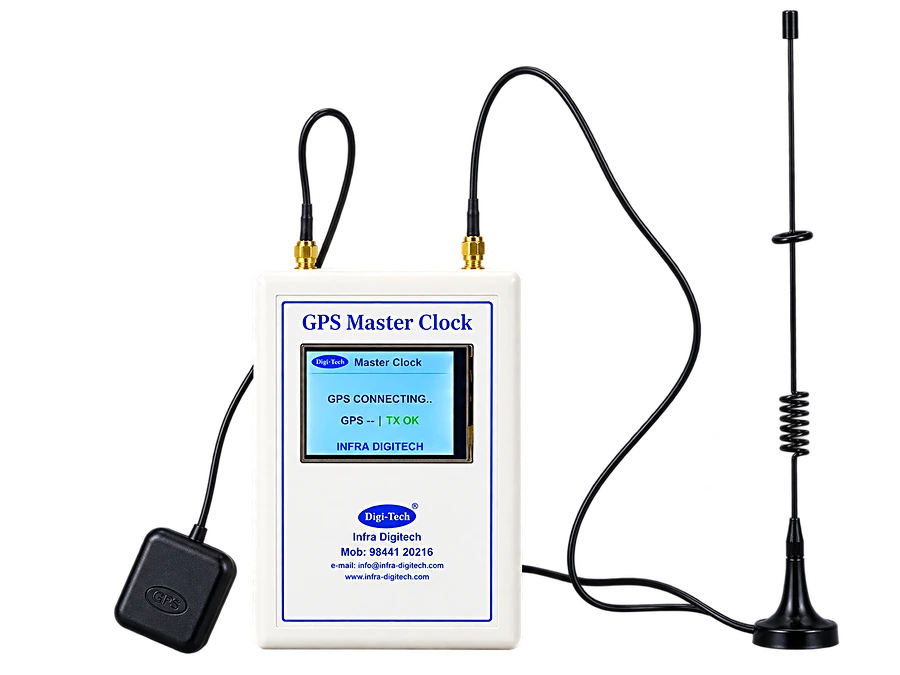
The only unit that has to see the sky
It is not a display for the wall of a room — it is the source, and it belongs wherever the antenna run is shortest. Two aerials leave it: the small GPS puck that listens to the satellites, and the whip on the magnetic base that sends the time out to the slaves. Separating them is deliberate, because the best position to receive from is rarely the best position to transmit from.
- Tracks up to 42 satellites — a partly obstructed sky is still a usable one
- Colour LCD showing the recovered time and the GPS and transmitter status together
- Separate GPS receive antenna and 865 MHz transmit antenna, so each can be placed on its merits
- Magnetic-base whip antenna — no drilling to reposition it during commissioning
- Wall-mounted enclosure, sited wherever the antenna run is shortest rather than where the clocks are
The master tells you what it is doing
Most timing equipment gives you a blinking LED and leaves you to guess. This one puts the receiver and the transmitter on the screen separately, which turns fault-finding into reading rather than testing — you know immediately whether the problem is the antenna position or the radio link.
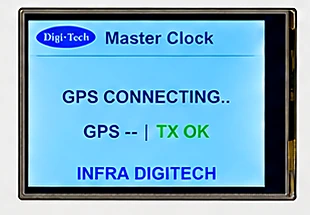
The screen itself, during acquisition.
What you see for the first minutes after power-up. The transmitter is already running — that is the TX OK — but the receiver has not yet resolved a fix. On a good antenna position this clears quickly; on a poor one it is the screen that tells you to move the puck before you finish the installation.
The working state, and the one a commissioning engineer photographs for the handover file. Satellite time is being recovered and it is going out over the radio link. Every slave in range is now displaying this second, and will keep doing so with no further attention.
The receiver has stopped resolving a fix. First check the obvious — the antenna lead, the puck position, anything metal newly parked over it. A failure that persists with a known-good antenna position points at the GPS module itself, and the master comes back to us for repair while the slaves carry on running from their own clocks.
A display with nothing to go wrong in it
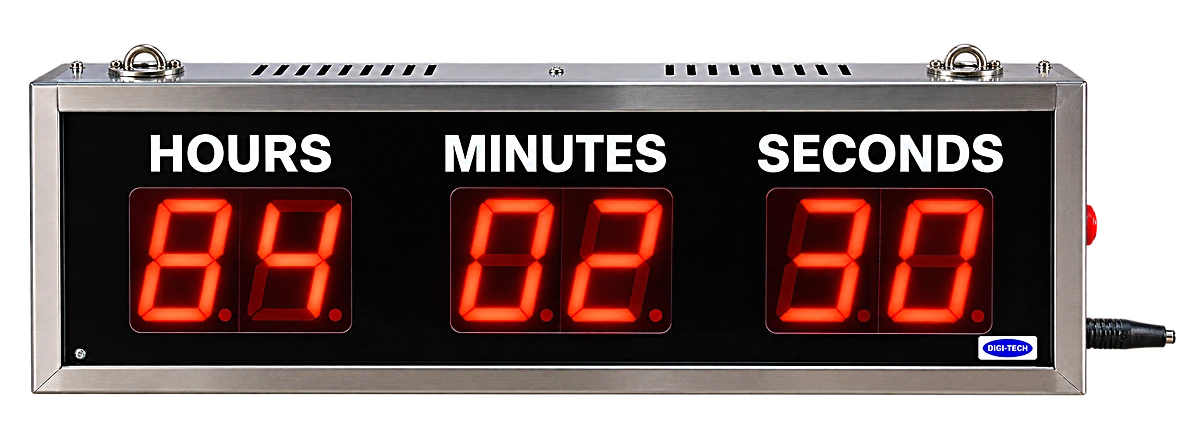
Hours, minutes and seconds, each under its own legend, in digits bright enough to read down a corridor. There is no GPS module inside, no antenna to route to a roof and no per-room signal survey — which is precisely why it can be installed in the rooms that made an independent clock impossible in the first place.
- Hours, minutes and seconds on separate labelled fields — read as a record, not glanced at
- High-brightness red seven-segment digits, legible the length of a corridor
- Stainless steel enclosure with lifting eyes for suspended or wall mounting
- Receives only — no GPS module, no antenna cable to the roof, nothing to survey per room
- Keeps running on its own real-time clock if the master ever goes quiet
The link between them
865 MHz, up to 650 m, and nothing in between. That band sits well below Wi-Fi, and low-frequency radio is far more tolerant of walls, floors and steel than the bands your data network uses — which is the whole reason it was chosen for this job rather than something faster.
India has de-licensed the band for short-range devices, so there is no spectrum licence for you to apply for and no annual fee attached to the installation. There is also no trench, no conduit and no cable schedule between the master and the clocks, which is usually the item that decides the project in an operating plant.
If the master falls silent
Every slave has its own real-time clock, and it keeps counting from the last time it was told. A slave that loses the master does not blank, does not freeze and does not need resetting — it carries on, and picks the synchronised time back up on its own as soon as the master returns.
That is the correct failure mode for a room where somebody reads the clock and writes the number into a record. A display that stops is noticed; a display that blanks leaves the operator with nothing at all. Over a long outage the free-running clocks will drift slowly apart, which is why the master's status screen is worth including in a routine walk-round.
Why a pharmaceutical site buys these
Not because the old clocks stopped. Because a batch record, an environmental monitoring log and an equipment printout carried three different times for the same event, and reconciling them cost more than the clocks would have. Here is what the guidance actually says — quoted, cited and not stretched.
MHRA 'GXP' Data Integrity Guidance, section 5.1
“appropriately controlled/synchronised clocks for recording timed events”
This is the closest thing in any regulation to a direct instruction to install a synchronised clock system, and it sits under the Contemporaneous element of ALCOA+. If your data-integrity procedure quotes ALCOA+ — and it almost certainly does — this clause is already in scope.
US FDA 21 CFR Part 11, §11.10(e)
“secure, computer-generated, time-stamped audit trails”
Part 11 requires time-stamped records rather than synchronised wall clocks in so many words. The connection is the one every auditor makes anyway: several systems producing time-stamped records only reconstruct into one timeline if they were all working to the same time.
EU GMP Annex 11, clause 12.4
“including date and time”
Records of who entered, changed, confirmed or deleted data must carry date and time. Where an operator reads that time off a wall before writing it into a batch record, the clock is part of the record-keeping system, not part of the furniture.
EU GMP Annex 1, clauses 4.5 and 4.7
“smooth, impervious and unbroken”
The reason a cleanroom clock is a different product from a factory clock. Surfaces must not shed particles, and must tolerate the repeated application of cleaning, disinfectant and sporicidal agents. That drives the material, the joint detail and the mounting — see the enclosure section below.
We have kept the quotations short and named the clause each one comes from, because a claim that will be read by a QA team should be checkable in a minute. If your site works to Schedule M, WHO GMP or a corporate data-integrity standard instead, send us the relevant section with your enquiry and we will map the system against it rather than assert that it complies.
What makes it a cleanroom clock
A clock in a classified room is a surface like any other, and it is judged the same way: does it shed, and does it survive being cleaned? That is a mechanical specification, not an electrical one, and it is taken room by room.
| Standard slave | Stainless steel cabinet, surface or suspended mount, as photographed above |
| Cleanroom slave | SS 304 or SS 316 front, sealed flush mount into the panel, no exposed fasteners |
| Ingress protection | IP65 front for washdown and disinfectant wipe-down areas |
| Cleaning | Specified for repeated IPA and sporicidal wipe-down — tell us your agent and we will confirm the gasket |
| Finish | Brushed or 2B mill finish; custom legends etched rather than stuck on |
| Classified areas | Suitable for installation in ISO 14644 classified rooms; grade and mounting detail confirmed per project |
Three things to settle before you order
Where the master goes
Not with the clocks. Put it where the GPS antenna has the shortest, cleanest run to a sky view — a plant room with an outside wall, a corridor near a window, a services floor. It then only has to be within radio range of the slaves, which is a much easier constraint to satisfy than a satellite view in every room.
How far the link reaches
Up to 650 m between the master and a slave. In a single-block pharmaceutical facility that generally covers the whole site from one position; across a campus with separated blocks it is worth marking the distances on a layout before we quote, because the answer may be a second master rather than a longer aerial.
What we hand over
A commissioned system, the master showing GPS and TX healthy, and the documentation your validation team will ask for. If your protocol needs specific evidence at IQ or OQ, send us the protocol at enquiry stage rather than after delivery and we will make sure the handover pack matches it.
The system, in one table
Everything we are willing to put in writing, and nothing we are not. Where a figure depends on your building rather than on our hardware, the table says so instead of quoting a headline number that will not survive the site survey.
| Architecture | One GPS master clock, multiple wireless slave displays |
| Time source | GPS satellite constellation, tracked by the master only |
| Satellites tracked | Up to 42 |
| Radio band | 865 MHz — de-licensed for short-range devices in India |
| Master to slave range | Up to 650 m |
| Cabling between units | None — the link is wireless |
| Master display | Colour LCD — time, GPS status and transmitter status |
| Master antennas | GPS puck receive antenna + magnetic-base whip transmit antenna |
| Slave display | Seven-segment LED, hours / minutes / seconds fields |
| Slave on signal loss | Runs on its internal real-time clock and resynchronises automatically |
| Slave enclosure | Stainless steel; SS 304 / SS 316 flush-mount cleanroom variants |
| Ingress protection | Up to IP65 front on cleanroom variants |
| Supply | 230 V AC, 50 Hz — UPS supply on request |
| Warranty | 1 year against manufacturing defects |
If your rooms all have a window or an accessible ceiling, you may not need any of this — an independent GPS clock per room is simpler and there is no radio link to think about. The comparison on the hub page is the quickest way to decide which of the two your site actually needs.
Master–slave clocks — common questions
Range, licensing, failure behaviour and the compliance questions a QA team asks before a purchase order is raised.
What is a master–slave clock system?
It is one clock that knows the time and a number of displays that do not. The master takes time from the GPS satellites, and every slave display simply shows what the master sends it. Because only one unit needs a satellite view, the slaves can go into rooms where a receiver would never work — sealed cleanrooms, basements, interior corridors and rooms under a steel deck.
Why not just fit an independent GPS clock in every room?
Where every room has a window or an accessible ceiling void, you should — it is simpler and there is no radio link to think about. The moment several of your rooms are sealed or buried, the alternative becomes running a separate antenna cable to each of them, and in a classified area that means a penetration through a wall that a validation team then has to accept. One master with a wireless link avoids all of it.
How far can a slave clock be from the master?
Up to 650 m. Building structure matters as much as distance, so on a multi-block site we would rather look at a layout than quote from a specification sheet — occasionally the right answer is a second master rather than a marginal link at the far end of the site.
Do we need a licence to run a wireless clock system in India?
No. The system runs in the 865 MHz band, which the Government of India has de-licensed for short-range devices, so there is no spectrum licence to obtain and no annual fee. The equipment approval side of it is our responsibility as the manufacturer rather than yours as the user.
Will it interfere with our Wi-Fi or our plant instrumentation?
It sits nowhere near the 2.4 GHz and 5 GHz bands your Wi-Fi uses, so there is no overlap there. Where a plant already runs other equipment in the 865 MHz band, that is worth raising at the survey — it is a straightforward thing to check on site and a very awkward thing to discover after installation.
What happens if the master stops sending?
Each slave clock has its own real-time clock and keeps counting from the last time it knew, so the displays do not blank, freeze or reset. When the master comes back the slaves pick the time up again automatically. The practical consequence of a long outage is drift rather than a stopped clock — which is the right failure mode for a room where somebody is writing the time into a record.
How many slave clocks can one master drive?
That depends on the layout and how the slaves are distributed, so we size it against your drawing rather than quoting a headline number. Send us the room list with distances from the proposed master position and we will tell you whether one master covers it.
Which regulations actually require synchronised clocks in a pharmaceutical facility?
The most direct is the MHRA data-integrity guidance, which asks for appropriately controlled and synchronised clocks for recording timed events, under the Contemporaneous element of ALCOA+. FDA 21 CFR Part 11 and EU GMP Annex 11 require time-stamped records and audit trails rather than naming clocks, but records from several systems only reconcile into one timeline if the time behind them was common. We would rather set that out precisely than claim a clause that does not exist.
Can the clocks be validated, and do you provide a calibration certificate?
Yes to both. We supply the documentation your validation team needs for installation and operational qualification, and a calibration certificate with the system. If your protocol calls for particular evidence or a particular format, send it with the enquiry — it is far easier to build the handover pack around your protocol than to retrofit it afterwards.
Is the slave clock suitable for a classified cleanroom?
The standard slave is a stainless steel cabinet, which suits pharmaceutical support areas, corridors and technical rooms. For classified space we build a cleanroom variant — SS 304 or SS 316, sealed flush into the panel, no exposed fasteners, IP65 front, specified for repeated disinfectant and sporicidal wipe-down. Tell us the room grade and the cleaning agent you use and we will confirm the build before you order.
Can we mix cleanroom slaves and ordinary ones on the same master?
Yes, and most pharmaceutical sites do. The enclosure is a mechanical decision taken room by room; the radio link and the electronics behind the display are the same. A single master will happily drive a flush-mounted SS 316 clock in a filling room and a plain stainless one in the corridor outside it.
Is the master-slave clock system made in India?
Yes — designed and manufactured by Infra DigiTech in Bengaluru, which is why the enclosure, mounting and finish are things we change per project rather than things you have to work around. We are ISO 9001:2015 certified and CE marked, and spares and service come from the people who built the unit.
Send us the layout
Mark the rooms that need a clock, the room grades, and one position where an antenna could reasonably see the sky. That is enough for us to tell you whether one master covers the site, what each slave should be built from, and what the system costs.