
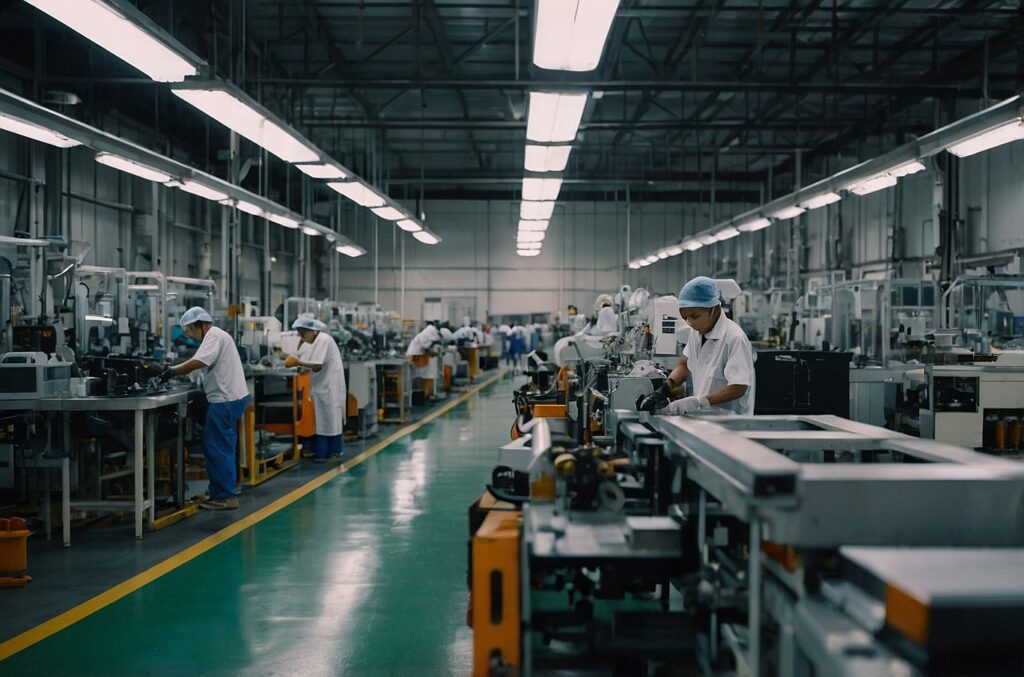
Andon — the production-floor signal system that originated at Toyota — is one of the highest-ROI lean manufacturing investments most Indian factories never make. Properly engineered, it shrinks the gap between a problem appearing on the line and being escalated to someone who can fix it from minutes to seconds. Here is what the architecture should look like and what payback to expect.
What Andon actually does
An Andon system is a visual signaling architecture: each workstation can declare its state — running, calling for materials, calling for maintenance, line stopped — by pressing a station button. That state is immediately visible on a central production display board, on supervisor mobile dashboards, and (in modern systems) logged to a production monitoring backend for analysis.
The colour code is universal: green for normal running, yellow for an issue detected (typically a material shortage or quality flag), red for line stopped. Three colours, instant comprehension, no language barrier. This is why Andon survived the export of the Toyota Production System and is now a global lean-manufacturing standard — the visual signal works on any shop floor regardless of operator language or geography.
Where the ROI actually comes from
The ROI is not from the Andon hardware itself — it is from the behaviour change the system enforces. Without an Andon, the time from 'problem detected' to 'supervisor responding' is governed by whoever happens to walk by, plus telephone tag, plus the supervisor's current workload. With an Andon, that time collapses to under 30 seconds for any active yellow or red state because the issue is visible from anywhere on the floor.
The 5-15% throughput range is wide because it depends entirely on baseline. A factory already running lean with strong supervisory discipline will see the lower end. A factory where issues frequently go unreported until end-of-shift will see the upper end — and the upper end is where the payback period collapses to under 90 days.
Architecture choices
Per-station signaling unit
At each workstation: a wired or wireless push-button with three (or four) coloured indicators, mounted at operator-reach height. The unit needs to be visible from the supervisor walkway and accessible to the operator without leaving the workstation.
Central production display
Above the line, visible from the entire shop floor: a large-format LED or LCD display showing the current state of every station, current shift production count vs target, and current quality flag (red / yellow / green based on first-pass yield). This is the always-on visual reference that drives the cultural change.
Supervisor mobile
A live dashboard on every supervisor's mobile or tablet — same data as the central display but personalized to their zone. Industrial IoT in the modern sense: the data the floor display shows visibly is also written to a backend for end-of-shift, end-of-day and trend analysis.
Sizing without over-spending
Three sizing rules: signal at every station that runs independently (not at every operator if 5 operators share one station), display once per direct line of sight (not once per line — if one display is visible from the whole floor, that is enough), and dashboard for every supervisor zone (not every supervisor if two supervisors share a zone).
A small Indian factory with one production line, 12 workstations and two supervisors typically needs 12 signal units, one central display and two mobile dashboards. That is the right baseline. A factory specifying 12 displays for 12 stations has been oversold — the value is in the consolidated visual, not in per-station redundancy.
Industrial belt deployments
Our installations across the Bengaluru-Chennai industrial corridor — Toyota Kirloskar (Bidadi), Yokogawa Bluestar (Electronic City, Bengaluru), Lakshmi Vacuum Technologies (Peenya), Ashok Leyland (Hosur) and TVS Industries (Hosur) — follow this sizing philosophy. The signaling architecture stays simple; the value comes from the supervisor response-time discipline the system enforces.
Considering Andon or production monitoring for a factory line? See our industrial display range and ROI breakdown.
Read about our industrial production displays